
From the studio
Scalp Micropigmentation on Long Hair: Who It Actually Suits
Scalp micropigmentation used to mean shaving your head. Density SMP works differently, placing pigment between your existing strands. Here's who it genuinely suits, honestly.
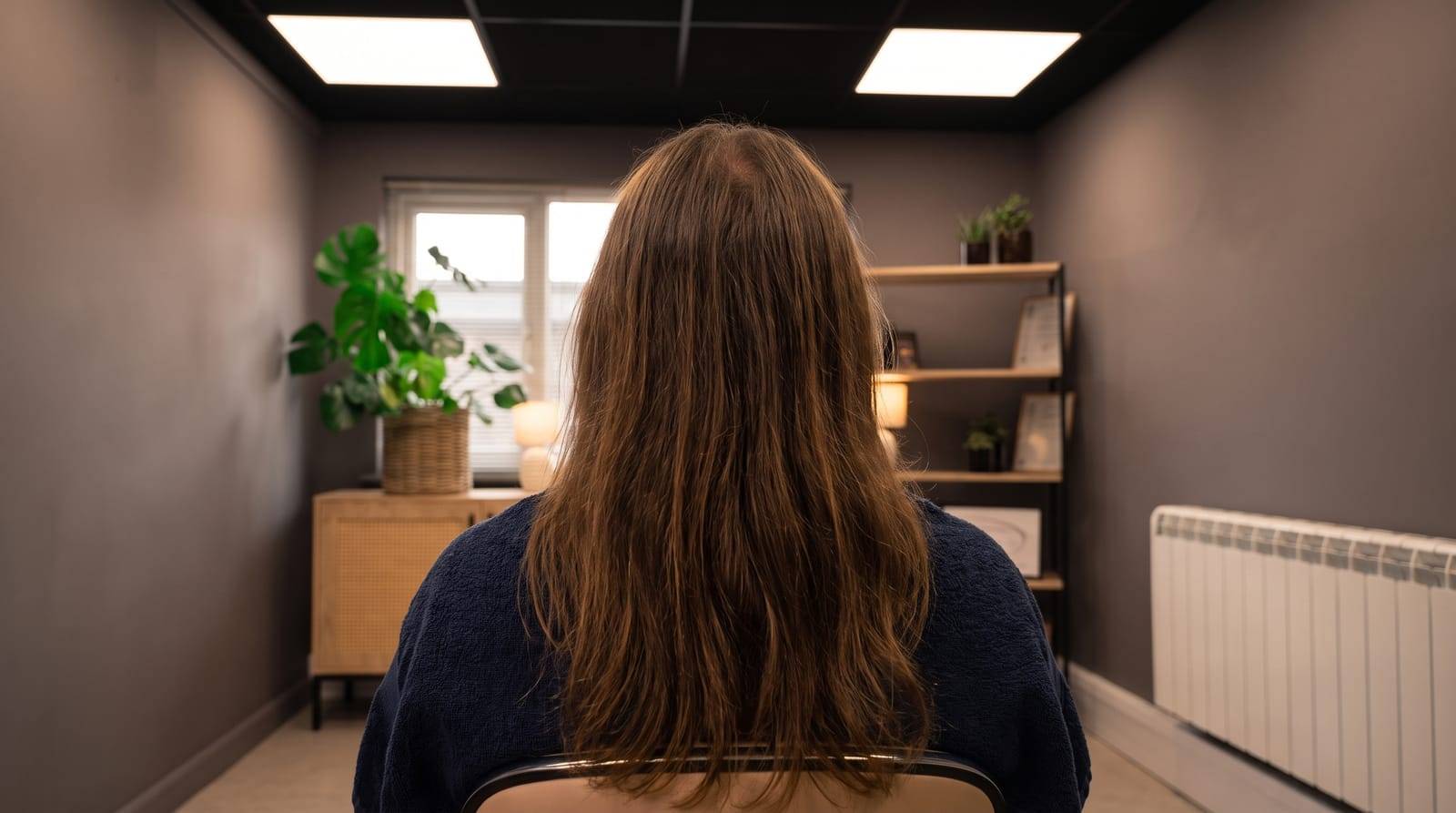
If the word “SMP” makes you picture a fully shaved scalp, you’re picturing one version of it, not the only one. A lot of the people who’d actually benefit from scalp micropigmentation have no intention of shaving anything. They’ve got a parting that’s wider than it used to be, or a crown that catches the light more than it did a few years ago, and they’d like that to stop being visible without changing how they wear their hair at all. That’s a genuinely different job to the one SMP is best known for, and it’s worth understanding properly before you rule it in or out.
The short answer
Yes, scalp micropigmentation works on long hair - it's called density SMP, and it places tiny pigment impressions between your existing strands to reduce how much scalp shows through, rather than replicating a shaved look. It suits genuine diffuse thinning where your hair loss has settled into a stable pattern. It is not a fix for an established bald patch sitting next to long hair, and no amount of skilled pigment work changes that.
Two different jobs, both called “SMP”
Most of what you’ll find searching this term describes classic hairline-replication SMP: tiny dots tattooed across a closely shaved scalp to look like a full head of stubble. It’s brilliant for what it does, and it’s the version most people have seen in a magazine or on a barbershop wall. But it isn’t the only application, and treating it as the only one is where a lot of the online confusion starts.
ISHRS, the professional body for hair restoration surgeons, draws the distinction plainly, describing two separate scenarios: SMP on a fully shaved head, and SMP on “low-density hair” - heads that “have hair everywhere… but just not as dense as the patient would like,” where, in their words, “SMP might be the next best step in treatment.” That second scenario is density SMP, and it’s a genuinely different service with a different goal: not to look shaved, but to look like your own hair has more of itself.
The practical result of that difference is the one thing every competitor page we researched gets tangled up on: how short your hair needs to be. For classic hairline SMP, it has to be short - one specialist source puts the working range at roughly 0.5mm to 3mm, because past about 6mm the pigment dots are largely hidden and the whole effect disappears. For density SMP, that rule simply doesn’t apply, because the pigment isn’t trying to pass as stubble. It sits beneath and between the hair you’re already wearing at whatever length suits you, closing the gap between skin and strand rather than replacing the strand altogether. “How short does my hair need to be for SMP” genuinely has two correct answers, and which one applies to you depends entirely on which result you’re after.
Who density SMP actually suits, and who it doesn’t
This is the part most SMP clinic pages skip past with a “book a consultation to find out,” and it’s worth being specific about instead. ISHRS gives an actual, sourced boundary rather than a vague one: SMP should generally be avoided where “a scalp has a completely bald area next to an area with longer hair… and relatively good density,” because a mix of visibly bald and clearly-haired scalp on the same head doesn’t read as natural whatever technique you use. In that situation, they note, a hair transplant into the bald area is usually the better-suited option.
That rules out one specific pattern. It doesn’t rule out the much more common one, which is diffuse thinning: your hair is there, all over, just less dense than it used to be, with the scalp starting to show through evenly rather than in one bald patch. That’s the pattern density SMP is built for, and it’s genuinely common on both sides. Men see it as limited, all-over thinning that hasn’t progressed into full baldness. Women see it differently again - DermNet NZ notes that female pattern hair loss “involves diffuse thinning across the scalp while preserving the frontal hairline,” a widening part rather than a receding one, which is exactly the shape a preserved hairline with a visible gap down the middle takes. If that sounds familiar, it’s worth reading our separate guide on scalp micropigmentation for women, which goes into that pattern specifically.
What we'd say at a consultation
Bring us your actual scalp, not your guess at it. "Diffuse thinning" and "a bald patch next to long hair" can look similar in a bathroom mirror under bad lighting and are two completely different conversations in the chair. We'd rather tell you honestly that density SMP isn't the right fit than take the work and leave you disappointed with the result.
Why your hair loss needs to be reasonably settled first
Here’s the honest catch that no ranking clinic page mentions clearly: density SMP works best when the hair loss it’s covering has more or less stabilised. The reason is mechanical, not marketing. DermNet NZ describes pattern hair loss as progressive, often moving in “accelerated phases… followed by periods of stability” rather than a smooth, predictable decline. The pigment we place is fixed. Your hair around it isn’t, if the loss is still active. If more hair falls out after treatment, the density we matched to your scalp at the time starts to look thinner than the pigment underneath it, and the two drift out of step. Google’s own AI Overview on this exact topic states the practical consequence in almost identical terms: it “requires stable hair loss or active medical management, because future un-medicated balding around the treated area can create an unnatural look.”
That’s not a reason to rule density SMP out. It’s a reason to have an honest conversation about where your hair loss currently sits before booking, and, if it’s still actively progressing, to look at managing that first.
The honest option set, before you get to SMP
This is the section most SMP clinic pages leave out entirely, because none of them sell anything else. We’d rather you knew the whole picture. The NHS names finasteride and minoxidil as “the main treatments for male pattern baldness,” with minoxidil also used for female pattern hair loss; neither is available on the NHS for cosmetic hair loss, so both come at your own cost, and the NHS is direct that “no treatment is 100% effective.” Wigs, both synthetic and real-hair, are listed too, alongside medical routes like steroid treatment and, in some cases, hair transplant surgery.
Transplant surgery deserves a specific honest note for anyone with diffuse thinning rather than one bald patch: it’s the option ISHRS names for a bald area sitting next to good-density hair, not for all-over thinning, where there usually isn’t a discrete bald “recipient” area and a thick “donor” area to move hair between. If your thinning is spread evenly across the top rather than concentrated in one patch, a transplant is often a harder, less predictable option than density SMP, not a straightforward upgrade from it.
None of this is a reason to avoid density SMP if the pattern fits. It’s context most people researching this aren’t given, and we think you’re better off having it before you decide anything.
What it looks like years down the line
Well-placed SMP typically lasts 5 to 10 years before it’s worth a touch-up to keep the density and definition looking sharp, with most people finding a refresh worth having somewhere in the first few years rather than waiting for it to fade out entirely. Sun exposure speeds fading, so a bit of sensible sun care on the scalp genuinely extends the result. None of this is unique to density work - it’s the same honest maintenance picture as any SMP, covered in more depth in how long scalp micropigmentation actually lasts - but it’s worth restating here because a touch-up is also the natural point to reassess density if your hair has changed in the meantime, which brings us back to the stability point above.
You don't need to shave your head for this to work. That's the whole point of the density service, not a caveat on it.
What a consultation actually covers
A free consultation is where we look at your actual scalp rather than guess from a description. We’d talk through how your thinning has progressed and whether it’s settled into a stable pattern, how much genuine density you have left to blend pigment among, and honestly, whether density SMP is the right call or whether something else - medical treatment first, or in rarer cases a transplant - would serve you better. Our Density SMP Treatment starts from £600, and the Female Density Treatment from £600, both run over multiple sessions so the result builds gradually rather than all at once. You can see what one session of density work actually achieves before you come in, and what a genuine before-and-after shows is worth a look too.
The bottom line
Scalp micropigmentation on long hair is real, and it’s called density SMP: pigment placed between the hair you already have, not a shaved-head look borrowed from a different service. It’s built for genuine diffuse thinning with a reasonably stable pattern behind it, not for an established bald patch, and getting that distinction right at consultation is what separates a result you’re happy with from one you regret. If you’ve noticed more scalp catching the light than it used to and you have no intention of shaving anything, that’s exactly the conversation a free consultation is for. Reading is scalp micropigmentation right for you is a sensible next step before you book.
More from the blog
Hairstyles for Thinning Hair (Men): A Barber-Honest Guide
The right haircut can make thinning hair look genuinely thicker, before you touch a single product. Here is which cut suits your pattern, which ones make it worse, and the honest point where a haircut stops being enough.
Scalp Micropigmentation for Women: The Honest Guide
A widening parting and more scalp catching the light, but your hairline hasn't moved? That's the classic pattern of female hair loss. What causes it, the medical options first, and when density SMP genuinely helps.
Shaving Your Head When You're Balding: The Honest Guide
Thinking of shaving it all off now the hair is going? Often the right call, but a balding head shaved down can look patchy: dense at the sides, bare on top. Here is the honest guide to the two looks and where SMP fits.
Common questions
Can you do scalp micropigmentation on long hair?
Yes, through density SMP, which places pigment between your existing strands rather than replicating a shaved hairline. It suits diffuse thinning and a widening parting, not an established bald patch sitting next to long hair - that combination doesn't blend convincingly whichever technique you use.
What is the best hair length for scalp micropigmentation?
It depends which SMP you mean. Classic hairline-replication SMP, the kind that recreates a closely-shaved look, needs hair kept short (roughly 0.5 to 3mm) so the pigment dots read as stubble. Density SMP for long hair works at whatever length you already wear, because the pigment sits underneath and between the strands rather than needing to be seen on its own. Confusing the two is where most of the disappointment online comes from.
Does SMP look good with long hair?
It can, provided there is genuine existing hair to blend the pigment with and a reasonable density and colour match to work from. Results look weaker the closer your scalp gets to a fully bald patch sitting next to long hair, which is exactly the case a proper consultation is there to catch before you commit to anything.
Will I regret scalp micropigmentation on long hair?
The two honest regret scenarios we'd flag are having it done while your hair loss is still actively progressing and unmanaged, so the treated area drifts out of step with the hair around it as more falls; and misunderstanding which type of SMP you actually bought, expecting a shaved-hairline look while keeping your hair long. Both are avoidable with a straight conversation before you start, not after.
What happens to scalp micropigmentation after 5 or 10 years?
Well-placed SMP typically holds for 5 to 10 years before a touch-up is worth having to keep the density and definition looking sharp. Left entirely unrefreshed, it fades gradually rather than all at once, and can be barely visible by the 10-year mark. A touch-up every 1 to 3 years is the more usual pattern than waiting for it to fade out completely.
Do I need to shave my head for density SMP?
No. That's the entire point of the density service. It's built for people who want to keep the hair they have and simply reduce how much scalp shows through it, not for recreating a shaved-head look.
Thinking about scalp micropigmentation?
Book a free, no-obligation consultation. We'll talk through your hair openly - no guarantees and no medical claims, just a clear idea of whether SMP is right for you.
Book a free consultation