
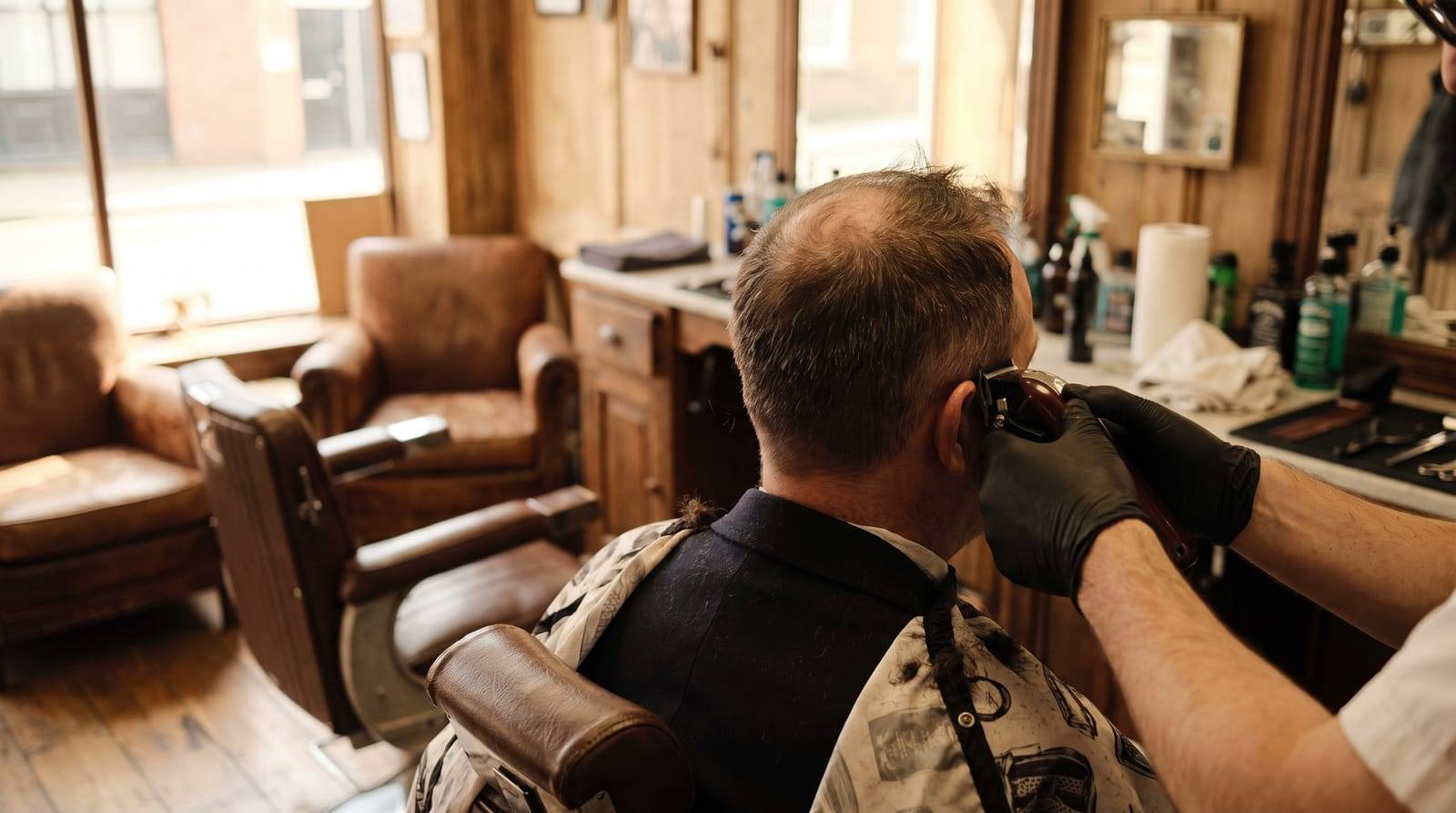
From the studio
Hairstyles for Thinning Hair (Men): A Barber-Honest Guide
The right haircut can make thinning hair look genuinely thicker, before you touch a single product. Here is which cut suits your pattern, which ones make it worse, and the honest point where a haircut stops being enough.
A good haircut is the cheapest, fastest thing you can do about thinning hair, and it works better than most men expect. It will not fix everything. Any guide that implies it will is not being straight with you. This one is: which cuts genuinely help depending on where you are thinning, which ones make it worse, and the honest point where styling stops being enough and something else has to take over.
The short answer
Short, textured, close-to-even-length cuts (a buzz cut, a textured crop, a crew cut, or a short back-and-sides) reduce how much scalp shows through thinning hair, because a short length keeps hair standing proud instead of collapsing flat under its own weight, while length and product weight both do the opposite. Which one of those suits you depends on your actual pattern: a receding hairline, a thinning crown, and a general diffuse thinning across the top each want a slightly different length and shape, which is why matching the cut to your own pattern beats copying a photo from a magazine. A haircut is the honest, free first move, but it has a real ceiling: once you have gone as short as a barber can reasonably take you and scalp still shows through, that is the point to have a different, more honest conversation about what comes next.
Match the cut to your pattern, not a photo
Most style guides show you a wall of 20-something haircuts and leave you to guess which one applies. That is backwards, because thinning hair does not show up the same way for everyone. According to the British Association of Dermatologists, the usual pattern is “a receding frontal hairline and loss of hair from the top of the head”, with the sides and back kept largely intact. In practice that splits into three shapes worth naming separately, because each one wants a slightly different cut:
- Hairline thinning - recession at the temples, an M or V shape creeping back, while the crown and top are still fairly dense.
- Crown thinning - a widening patch at the back-top of the head, often spotted first in a photo taken from above, while the hairline itself has barely moved.
- Diffuse thinning - a general reduction in density across the whole top, without one obvious patch, which is the pattern most female clients see too and the one our guide to scalp micropigmentation for women covers in full.
Plenty of men have some combination of all three, and it changes over time, so it is worth checking where you actually stand. Our guide to the Norwood scale walks through the full staging if you want to place yourself properly, and receding hairline treatment or what actually helps a balding crown go deeper on either pattern specifically.
Jump straight to a section: the cuts that help · what to avoid · what a haircut can’t fix.
Why a short cut actually works
The mechanism is worth understanding, because it explains why “just get it cut shorter” is not lazy advice, it is the correct one. Longer hair collapses under its own weight, which exposes more bare scalp per strand than a short length does. Keep the hair short and roughly even, and every strand stands slightly away from the scalp instead of lying flat against it, so the gaps between hairs are far less visible from a normal viewing distance. A light matte texturising product on top can add a touch more lift once you have the length right, but it is a small finishing step, not the fix: the cut is doing almost all of the work.
A real UK barber put it plainly to GQ: “Keep the back and sides shorter as this will allow the hair on top to look thicker.” It is craft knowledge rather than a medical finding, but it is consistent across every barber and grooming source that has written about it, and it is the same logic every named style below relies on.
Longer hair does not hide thinning. It exposes it, because weight flattens hair against the scalp and widens every gap between strands.
Named cuts that genuinely help, by pattern
None of these need a wig or anything beyond a normal barber appointment. They are ordered from lowest to highest maintenance, and the pattern next to each one is where it earns its keep.
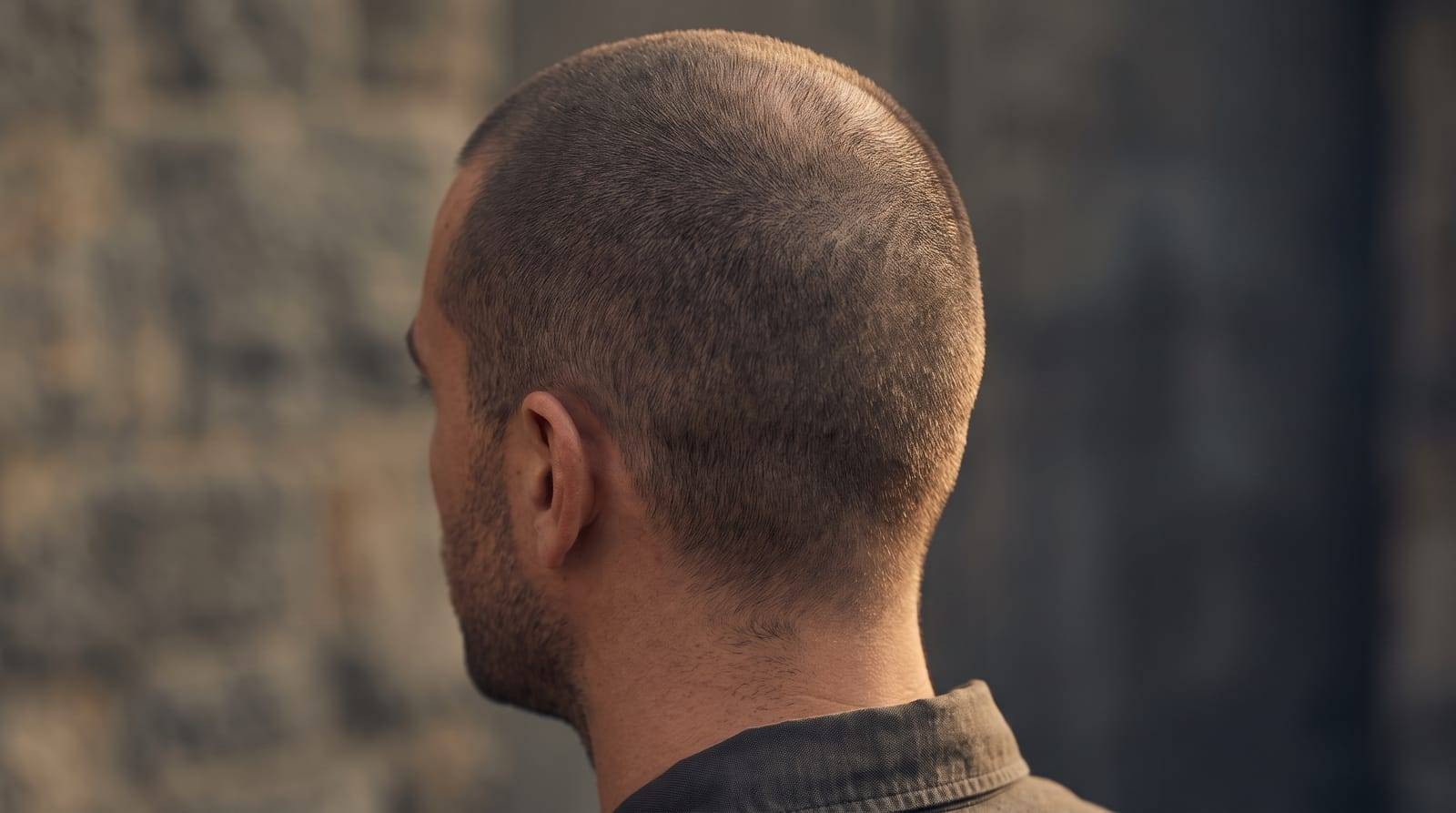
Buzz cut or crop (any grade)
The simplest, most effective option for advanced or diffuse thinning, because every hair is the same short length so there is nothing longer to expose a shorter patch. It is also the lowest-upkeep style here: a trim every couple of weeks with clippers you can own yourself.
Textured crop / French crop
Short, tight sides with a slightly longer, choppy, textured top. The texture on top adds visual lift and movement without adding real length, which suits hairline thinning particularly well because it keeps weight off the front while still giving you something to style.
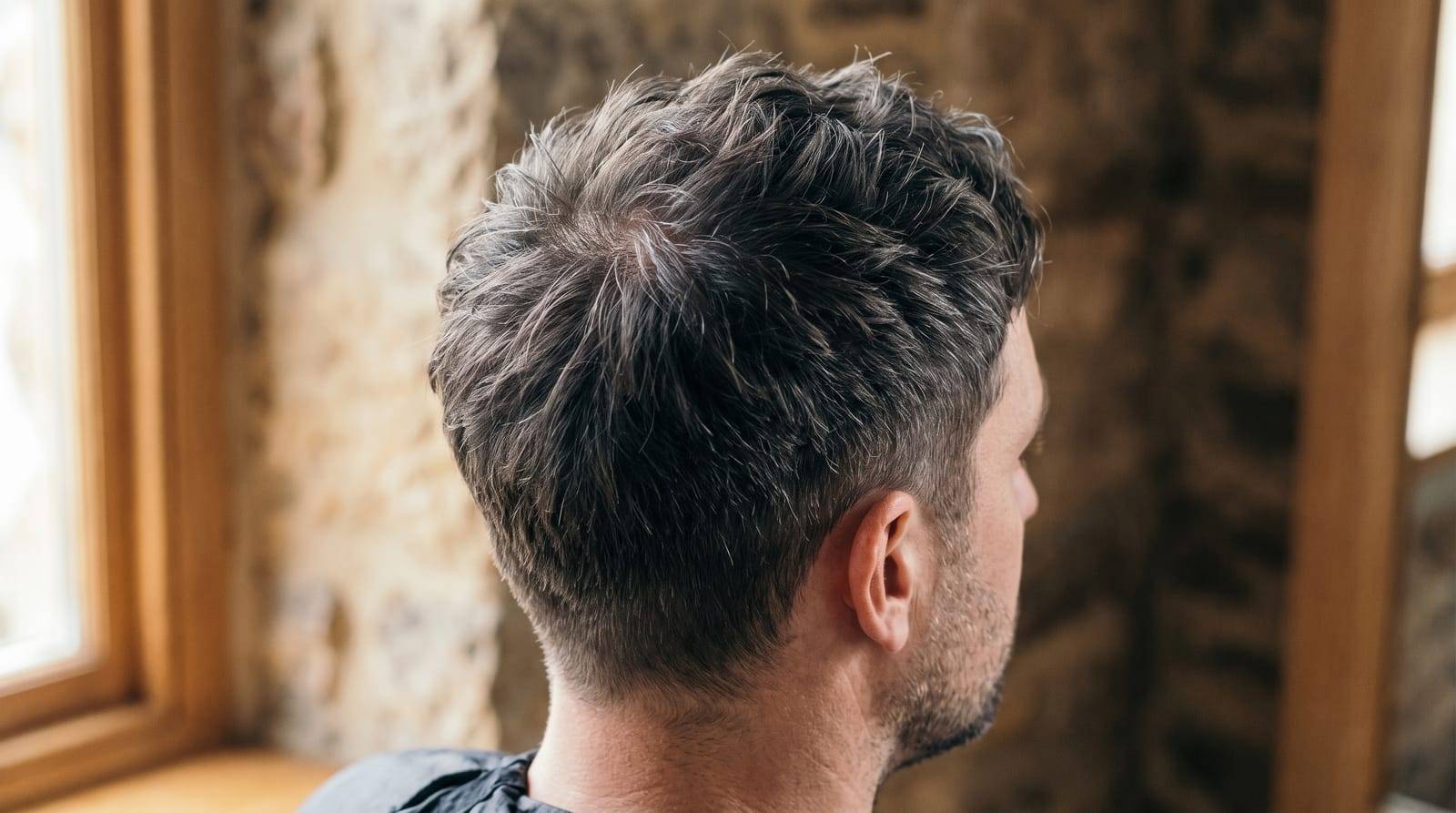
Crew cut
Short, even, blended from the sides into a slightly longer top, with none of the sharp lines of a skin fade. It reads as tidy and deliberate rather than “trying to hide something”, and it works well across all three patterns because it does not draw the eye to any one area.
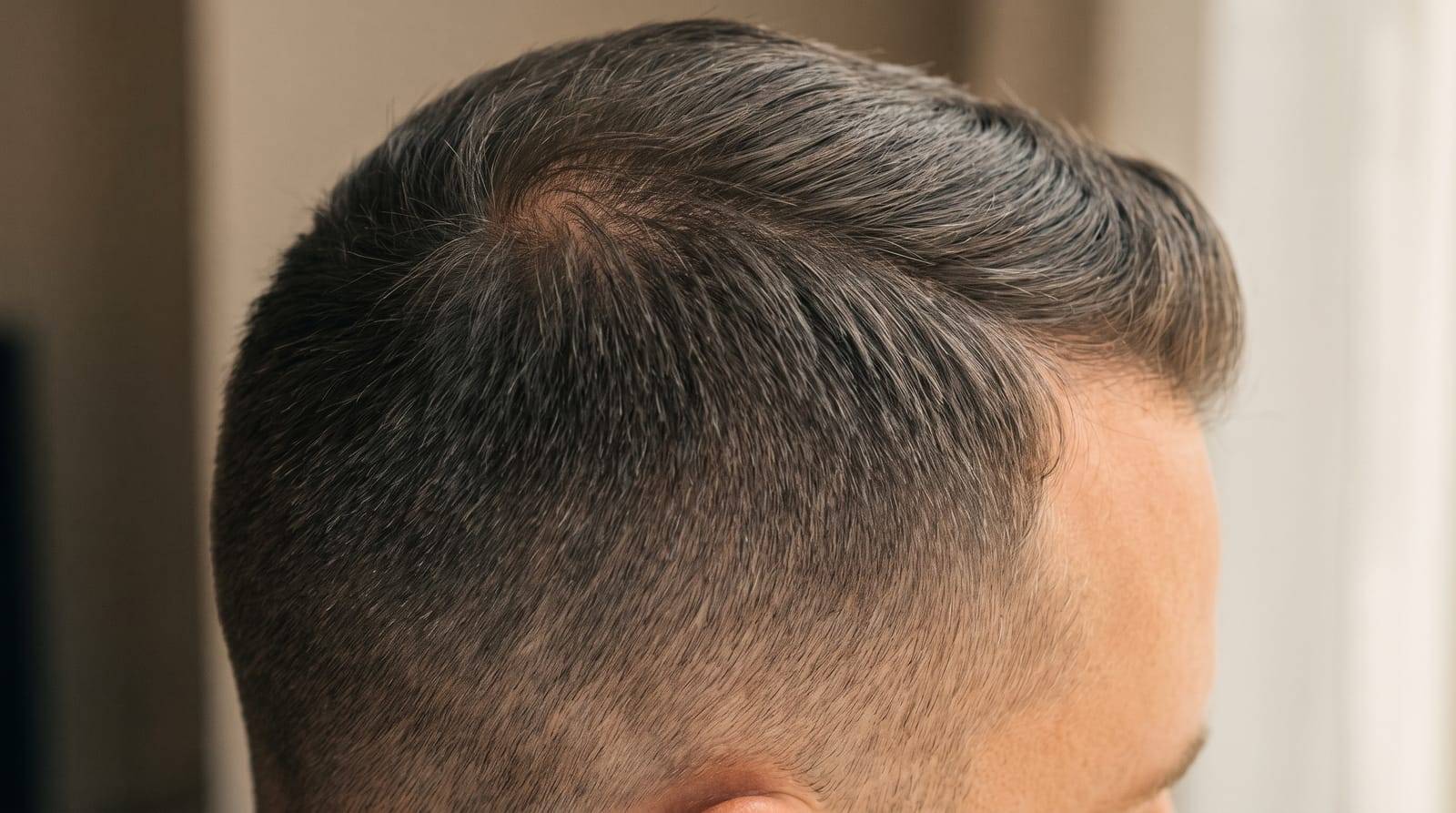
Short back-and-sides with light top texture
Keeps more length up top than the styles above, styled up rather than flat, which specifically helps crown thinning: lifting the front visually compensates for reduced density behind it, the same way a quiff or soft pompadour does for a fuller head of hair.
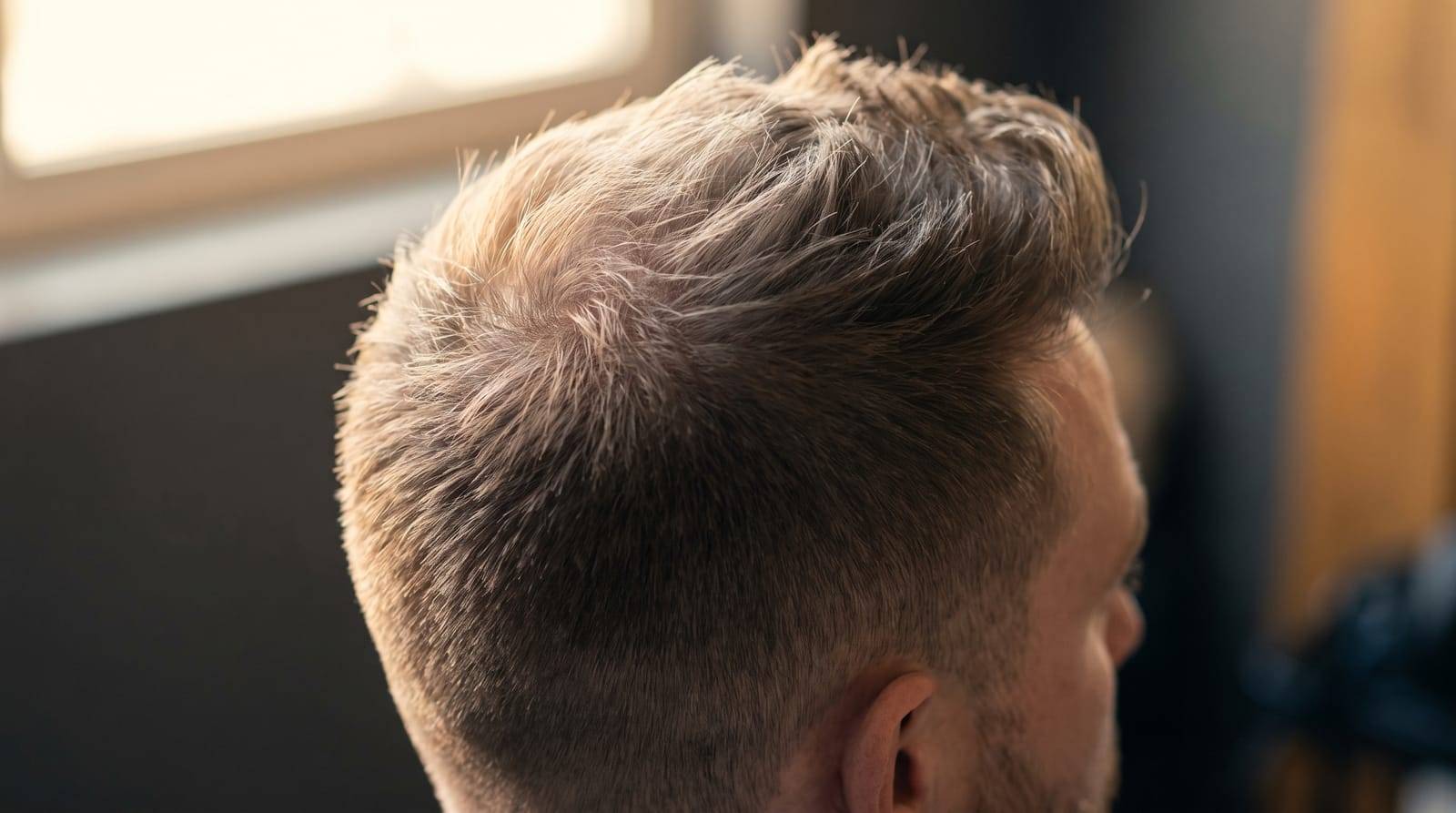
Which cut for which pattern
- Hairline receding, crown still dense: a textured crop or crew cut, kept short and even at the front.
- Crown thinning, hairline holding: a short back-and-sides with light texture styled up, to lift density visually where it is thinnest.
- Thinning all over (diffuse): a buzz cut or close crop, the simplest fix once one area no longer stands out from another.
- Advanced thinning, any pattern: the shortest end of the buzz-cut range, or start weighing up what comes after a haircut, below.
Cuts and styles to avoid
Every style below does the opposite of the mechanism above: it adds length or weight in exactly the place that cannot support it.
The comb-over
Drawing hair from a side part across a thinning area is the single worst-rated move across every barber source we checked, and it is easy to see why: the boundary between covered and bare skin becomes the most visible thing on the whole head, more noticeable than the thinning itself would have been left alone.
Long, flat or heavily slicked-back styles
Length and product weight both flatten hair down against the scalp, and a slicked-back style specifically “exposes the scalp more than you planned” once product weighs it down, according to the same barber source. A flat centre parting does the same on a smaller scale: it draws a dead-straight line of visible scalp right down the middle of the head.
A hard clipper line against soft, thinning hair
This one is subtler. A sharp, high-contrast fade edge is designed to look crisp against dense hair. Against thinning hair it can look unnaturally severe, because there is less density either side of the line to soften it. A scissor-finished, softer edge usually reads better on genuinely thin hair.
What a haircut cannot fix
Style is camouflage, not correction. It does not restore density, it stops disguising loss convincingly once thinning passes a certain point (there is no cut that hides a fully bald crown), and it has to be maintained with regular trims rather than being a one-off fix. Every serious grooming guide that recommends "get it cut shorter" is, by implication, admitting a haircut alone has a ceiling. This guide is not going to pretend otherwise.
The honest option set beyond a haircut
If you have read this far because a haircut on its own is not quite doing it any more, here is the full picture, including the routes we do not sell, because a guide that only mentions the one thing it is selling is not a guide.
Minoxidil and finasteride. The NHS names these plainly as “the main treatments for male pattern baldness,” and is equally plain that they “are not all available on the NHS, so can be expensive if you have to pay.” Minoxidil is a topical treatment, over the counter in the UK as Regaine, and the British Association of Dermatologists (BAD) describes it as something that “may help to slow down the progression of hair loss and act[s] as a hair growth stimulant.” Finasteride is a prescription-only tablet that lowers DHT, the hormone driving the thinning in the first place, and the BAD notes it “may slow hair loss and possibly help regrowth of hair.” Both are maintenance therapies rather than cures: the benefit holds only while you keep taking them.
A hair transplant. The lasting, hair-growing surgical option for an established bald area, moving your own donor hair into the thinning zone. We have a full, sourced breakdown of what one actually costs in the UK by graft count in our hair transplant cost guide, and an honest look at the scarring it leaves behind if that is a factor for you.
Wigs, hairpieces and hair fibres. The BAD’s own patient leaflet lists “wigs, toupees, and hair extensions” and “spray preparations with pigmented fibres” among the recognised cosmetic camouflage options for hair loss, alongside the pharma routes above. If you already use, or are considering, the shake-on fibre powders, our honest comparison of hair fibres and SMP covers exactly where they help and where they run out of road. If a hairpiece is on your list, read what a hair system really costs over five years before you commit to one.
Scalp micropigmentation. The NHS itself lists “permanent make-up (micropigmentation)” among hair-loss options, describing it as a “tattoo used to look like short hair.” It sits in the same cosmetic-camouflage category as wigs and fibres above, not the medical or surgical routes, and we would rather say that plainly than let the distinction blur.
Where SMP becomes the natural next step
Here is the honest bridge, not an early pitch: scalp micropigmentation does the same job a great short haircut does, reducing the visible contrast between hair and scalp, except permanently rather than every four to six weeks. It becomes worth a proper look for two specific readers.
If you have already gone as short as a barber can reasonably take you and can still see a lot of scalp through a crown or diffuse thinning pattern, Density SMP (from £600) adds thousands of tiny pigment impressions between the hairs you still have, reducing the same hair-to-scalp contrast a short cut is also trying to solve, just without needing a trim every few weeks to maintain it.
If you have decided the honest answer for you is to shave down fully, Full SMP (from £1,000) recreates a natural hairline and an even density across the scalp, so a fully shaved head reads as one deliberate, consistent look rather than a patchy shave where dense stubble meets bare skin, which our guide to shaving your head when balding covers in more depth if that is the route you are weighing.
Neither of these grows hair, stops the underlying DHT-driven loss, or replaces seeing a GP if something about your loss feels sudden or unusual rather than gradual. Individual results vary, and pigment fades gradually over a few years, so it is a long-lasting finish rather than a one-off forever fix. What it does honestly do is take the exact camouflage principle behind every cut on this page, and make it permanent.
The bottom line
A short, textured, even-length cut is the honest, free first move for thinning hair, and it works better than most men expect, whichever of the three patterns (hairline, crown or diffuse) you are dealing with. It has real limits: it will not restore density, it needs regular trims, and no cut disguises loss forever. The medical route (minoxidil, finasteride) can slow the loss and partly thicken it for as long as you use it; a transplant can restore it surgically; wigs and fibres cover it daily. Scalp micropigmentation is a different, honest answer again: not a haircut, not a medication, but a permanent way to keep the same low-contrast look a great cut gives you, once a cut alone has done all it can. A free consultation is the straightforward way to work out which side of that line you are on, or read is scalp micropigmentation right for you before you come in.
More from the blog
Scalp Micropigmentation on Long Hair: Who It Actually Suits
Scalp micropigmentation used to mean shaving your head. Density SMP works differently, placing pigment between your existing strands. Here's who it genuinely suits, honestly.
Scalp Micropigmentation for Women: The Honest Guide
A widening parting and more scalp catching the light, but your hairline hasn't moved? That's the classic pattern of female hair loss. What causes it, the medical options first, and when density SMP genuinely helps.

Shaving Your Head When You're Balding: The Honest Guide
Thinking of shaving it all off now the hair is going? Often the right call, but a balding head shaved down can look patchy: dense at the sides, bare on top. Here is the honest guide to the two looks and where SMP fits.
Common questions
What is the best hairstyle for men with thinning hair?
Something short, textured and roughly the same length all over: a buzz cut, a textured crop or a crew cut. The mechanism is simple: longer hair collapses under its own weight and shows more scalp per strand, while a short, even length keeps every hair standing slightly proud, so the gaps between them are far less visible. There is no single 'best' cut for everyone, though, because a hairline that has receded and a crown that has thinned suit slightly different lengths and shapes, which is the whole point of matching the cut to your pattern rather than copying a photo.
What haircuts should you avoid with thinning hair?
Anything that relies on length or weight to hide a patch. The classic comb-over is the worst offender, because it draws hair across the thin area and puts the boundary between covered and bare skin on show, which the eye finds far more than the thinning itself. Long, flat or heavily slicked-back styles do the same thing on a bigger scale: the extra length and product weight flatten the hair down, exposing more scalp than a short cut ever would. A hard, sharp clipper line against thinning hair can also look more brutal than a softer, scissor-finished edge.
Does thinning hair look better short or long?
Short, consistently, across every barber and grooming source that has looked at this. Long hair adds weight, and weight flattens hair down against the scalp, which increases the visible gap between strands rather than hiding it. A short, even length keeps hair standing away from the scalp, so less skin shows through per square inch. It is a genuinely counter-intuitive result for a lot of men, who assume more hair means more coverage, but the opposite is usually true once thinning has properly set in.
Should I just cut my hair short if it is thinning?
As a first move, yes, and it costs nothing beyond your normal barber visit. A shorter, more textured cut is the honest place to start, because it is free, reversible and it genuinely helps for most patterns of thinning. It has real limits, though: it will not restore density, it needs maintaining every few weeks, and once thinning passes a certain point no cut disguises it convincingly. If you have already gone as short as a barber can reasonably take you and can still see a lot of scalp, that is the point worth having an honest conversation about what comes next.
What vitamin deficiency causes thinning hair?
For most men noticing gradual, patterned thinning at the hairline or crown, the cause is not a vitamin deficiency at all: it is male pattern hair loss, driven by genetics and the hormone DHT, and no supplement changes that. A nutritional cause, low iron or a deficiency picked up through diet, tends to cause a different picture: more diffuse, sudden shedding across the whole scalp rather than a receding hairline or a widening crown. If your hair loss came on quickly or all over rather than gradually in a pattern, that is worth a GP visit and a blood test rather than guessing at a supplement.
Can thinning hair grow back?
Not on its own, if the cause is male pattern hair loss, because the underlying process (DHT gradually shrinking genetically sensitive follicles) does not reverse itself. Two medications, minoxidil and finasteride, can slow the loss and partly thicken hair that has only miniaturised rather than disappeared, but only for as long as you keep using them, and the NHS notes they are not always funded. Once a follicle has stopped producing a visible hair, styling will not bring it back, and neither will scalp micropigmentation, which recreates the appearance of density rather than growing anything.
What are the 'big 3' for thinning hair?
It is grooming and pharmacy shorthand, not an NHS or dermatology term, for the three most commonly combined hair-loss treatments: minoxidil, finasteride, and a ketoconazole shampoo (sold as Nizoral). The first two have real NHS and BAD backing as 'the main treatments for male pattern baldness', and lowering DHT and stimulating growth respectively. Ketoconazole shampoo is the weakest-evidenced of the three; it is included because it may modestly reduce scalp inflammation and has some DHT-blocking action, but it is not named by the NHS or BAD alongside the other two, so treat it as the optional third rather than an equal partner. None of the three is a substitute for the styling advice above; they work on the hair you have left, not the visible contrast a good cut already fixes for free.
Thinking about scalp micropigmentation?
Book a free, no-obligation consultation. We'll talk through your hair openly - no guarantees and no medical claims, just a clear idea of whether SMP is right for you.
Book a free consultation