

From the studio
How Long Does Scalp Micropigmentation Last? The Honest Timeline
Every SMP page says three to six years and stops there. Here is the actual reason pigment fades, the factors that genuinely speed it up, and an honest answer on when you will want a touch-up.
Every studio’s website says roughly the same thing about how long scalp micropigmentation lasts: three to six years, give or take, then a touch-up. That much is true, and it comes up again and again for good reason. What almost none of them say is why it fades, which matters if you are trying to decide whether that is a problem or just how the treatment works. Here is the honest answer to both.
The short answer
Scalp micropigmentation commonly lasts three to six years before it visibly softens, because the immune system slowly clears the pigment and sunlight breaks it down chemically. Both processes are ordinary and expected, not a sign anything has gone wrong, and a touch-up brings the result back rather than starting over.
Why does scalp micropigmentation actually fade?
Most clinic pages stop at “your body absorbs it over time” and leave it there. That is true, but it skips the part that actually explains what is happening under the skin, and it is more specific than most people assume.
Pigment for scalp micropigmentation sits shallow, in the upper layer of the skin, deliberately placed there rather than deeper the way a decorative body tattoo often is. That shallow placement is exactly why it can look so precise and stubble-like, and it is also part of why it moves over time rather than sitting untouched for decades. Once it is in place, your skin’s own immune cells, called macrophages, treat the pigment as something to deal with. They absorb the tiny particles and hold onto them, because the particles are too stable to break down chemically. That would be the end of the story, except those immune cells do not live forever. When one dies, a new one moves in to take up the pigment it was carrying, and in that handover, a small amount is never fully recaptured. It drains away instead. Repeated over years, that slow, cell-by-cell handover is the real reason the result gradually lightens rather than staying fixed, and it is a documented process, not a guess: a 2018 study in the Journal of Experimental Medicine mapped out exactly this capture-and-handover cycle in skin.
Sunlight adds a second, separate mechanism on top of that. Ultraviolet light chemically breaks down the kind of pigment used in tattooing, quite apart from anything your immune system is doing, a reaction demonstrated directly on tattoo pigment back in 2007. That is why sun exposure is the one factor almost every studio agrees on, and it is also the one with real evidence behind it, unlike some of the other claims floating around, which we will come to next.
Between the two, the honest technical answer to “why does it fade” is: partly your skin naturally clearing the pigment over years, and partly the sun breaking it down chemically. Neither is a flaw in the work. Both are simply how any pigment placed in skin behaves over time.
What actually speeds up fading
- Sun exposure genuinely speeds fading, and it is the one factor with solid evidence behind it. Daily SPF on an exposed scalp is the single biggest thing within your control.
- Skin type is often blamed too, and different studios will even tell you opposite things about which skin type fades faster. The truth is nobody has properly proven either claim, so treat it as a minor, uncertain factor rather than the main one.
- How your skin naturally clears pigment happens on its own timeline, largely unaffected by anything you do. It is the quiet, background reason fading never fully stops, even with perfect aftercare.
- Good aftercare early on helps the result settle and hold well from the start, but it slows fading rather than preventing it altogether.
Is scalp micropigmentation permanent?
This is really two different questions wearing one phrase, and separating them is the honest answer. Technically, yes: a trace of the pigment stays in the skin indefinitely, because the body never fully clears every last particle. But that is not what most people actually mean when they ask. What they want to know is whether the sharp, defined look they leave their first session with will still look that way in five or ten years, and the honest answer there is no, not without a refresh. The visible result softens and lightens gradually, on the timeline described above.
Put plainly: scalp micropigmentation is long-lasting rather than permanent. That distinction is not a technicality designed to soften bad news. It is genuinely useful, because it means the decision is not as fixed as it might feel. The look can be adjusted, refreshed or gently reshaped over the years as your hairline or your preferences change, rather than being locked in for life the moment you leave your first appointment.
A result that fades gently and can be refreshed is a much smaller commitment than one that is fixed forever, whichever way you look at it.
Does it fade the same everywhere on the scalp?
Not quite, and this is one place where a genuinely honest answer needs to go further than “three to six years” as a single number for everyone.
Ordinary scalp skin, whether you are having a full treatment or density work to blend with existing hair, takes and holds pigment fairly consistently, and the standard three-to-six-year range applies. Scar camouflage work is different. Scar tissue is structurally less even than normal skin and holds pigment less predictably, and research on scarring specifically has found it fades measurably faster than SMP placed on ordinary, unscarred scalp. If your work includes a hair-transplant donor scar or another scar on the scalp, it is realistic to expect that area to need attention sooner than the rest, and an honest practitioner should tell you that before you start rather than let you find out later.
Fading is also rarely perfectly even across a single treated area, scar or not. Sun exposure is not identical everywhere on your scalp, and neither is how your skin healed the first time, so a touch-up often means re-depositing pigment where it has thinned most rather than redoing everything from scratch.
What happens after five years, and when should you get a touch-up?
There is no fixed expiry date, and treat anyone who gives you one with a little suspicion. In the first couple of years, most people notice very little change. Somewhere from around the three-year mark, a gentle lightening becomes noticeable if you are looking for it, and that is the natural point most people start to think about a refresh, though plenty wait longer and are perfectly happy doing so.
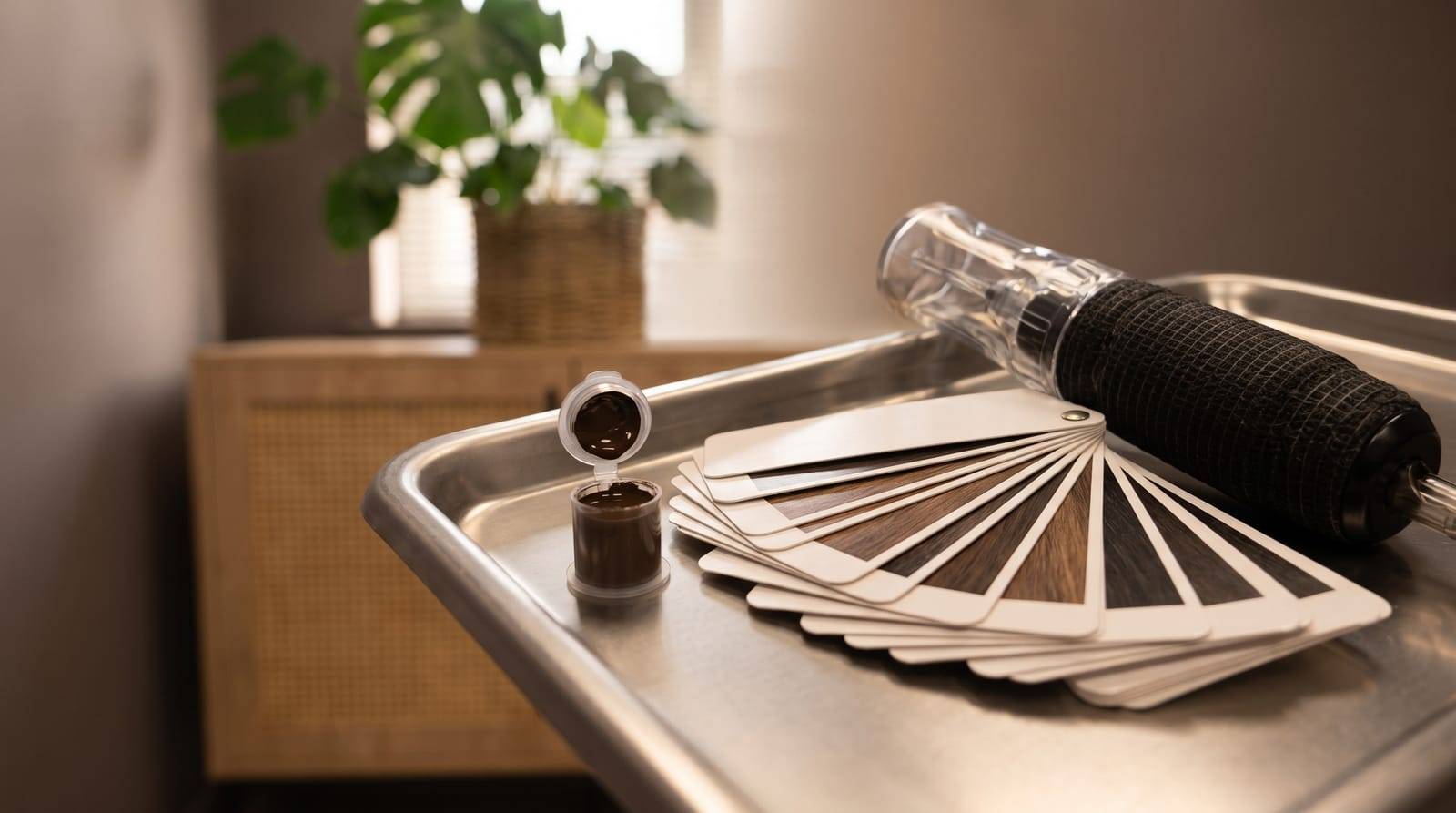
A touch-up is a genuinely smaller thing than the original treatment: £300, usually one session of a few hours, focused only on the areas that have actually faded rather than starting again from nothing. Stephen colour-matches to your current healed tone, since it can shift slightly over the years, re-deposits where density has thinned, and can make small adjustments to the hairline or shape if you want them at the same time. It is also a fair moment to raise anything you were never quite happy with, whatever studio did the original work.
What we'd say at a consultation
If you are weighing up SMP now and fading is the thing giving you pause, it helps to see it as ongoing maintenance rather than a countdown. Most of our clients find a touch-up every few years a small, welcome refresh rather than a chore, and it is a good opportunity to gently adjust the look as you age rather than being stuck with a decision made years earlier. We will always tell you honestly what we think your specific scalp and skin are likely to need.
The bottom line
Scalp micropigmentation fades, and that is not a flaw to be worried about. It happens for two real, ordinary reasons: your skin’s own immune cells slowly clear the pigment over years, and sunlight breaks it down chemically on top of that. Together they explain the three-to-six-year range nearly every studio quotes, without you having to just take that number on faith. Scar work tends to need attention sooner than a standard hairline or density treatment. And technically permanent is not quite the right word for any of it: long-lasting, with the option to refresh when you want to, is the honest description. If you are deciding whether that trade-off suits you, a free consultation is the most useful next step, and we will talk you through what to realistically expect for your own skin.
Curious what a hair tattoo actually involves before you get to the longevity question? Read our hair tattoo guide first, or if fading is one of several things making you hesitate, our honest look at scalp micropigmentation regrets covers the wider decision. You can also see real examples in our results.
More from the blog
Density SMP Treatment After One Session
A first density SMP session can already soften the contrast between hair and scalp on thinning areas, but a natural, settled result is built gradually. Here is a realistic look at what one session can and cannot do.

Before and After Scalp Micropigmentation: What Really Changes
A before-and-after can make SMP look like one instant switch. Here is what really changes, how the result is built, and how to tell an honest before-and-after from a flattering photo.

What a Hair System Really Costs in the UK (Over Five Years, Not One)
Salon price lists quote one unit. Nobody adds up the refits, the replacements and the tape. So I did, using the published prices of real UK salons, and the five-year number is the one worth knowing before you start.
Common questions
How long does scalp micropigmentation last?
Commonly three to six years before it visibly softens, though that is a range, not a promise. Sun exposure, your own skin and how well the original work was placed all move that number around, and our own clients often hold their result for three to seven years before wanting a refresh. It never simply expires on a fixed date. It fades gradually, and you decide when it is worth topping up.
Is scalp micropigmentation permanent?
Not strictly, though it is not temporary either, which is a fair thing to find confusing. A trace of the pigment stays in the skin for a very long time because the body cannot fully break it down, but the sharp, dark look you leave your first session with does soften and lighten over years. So it is honestly best described as long-lasting rather than permanent: the visible result needs refreshing periodically, even though it is not something that simply disappears if left alone.
Why does scalp micropigmentation actually fade?
Two real things are happening, not just a vague sense that it wears off. Sunlight breaks the pigment down chemically over time, which is why sun protection genuinely matters. And separately, your skin's own immune cells treat the pigment as something to deal with: they absorb it, and each time one of those cells dies and gets replaced, a small amount of pigment is not fully recaptured and drains away. That second process happens slowly regardless of sun exposure, which is why even careful aftercare only slows fading rather than stopping it.
Does scar camouflage SMP fade faster than normal SMP?
Yes, and it is worth knowing that going in. Scar tissue is different from normal scalp skin: it holds pigment less evenly and, in published research, has been shown to fade noticeably faster than SMP placed on ordinary scalp. If you have had scar camouflage work, it is realistic to expect a touch-up sooner than you might for a standard hairline or density treatment, and we will tell you honestly what to expect for your specific scar at a consultation.
What actually speeds up fading, and what can I control?
Sun exposure is the biggest factor within your control, and it is the one with the clearest evidence behind it, so daily SPF on an exposed scalp genuinely helps. Skin type is often mentioned too, and it probably plays some part, but the evidence for exactly how is much thinner than clinics tend to suggest, so we would rather be straight about that than repeat a claim we cannot back up. Beyond that, the gradual immune-driven fade is not something aftercare changes much: it happens at its own pace regardless of what you do.
Will I regret getting SMP because it fades?
Most people end up seeing it the other way round. A result that is fixed forever would be a much bigger decision to commit to; one that gently softens over years, and can be refreshed or gently adjusted as your face and hairline change, takes some of that pressure off. If fading itself is what is holding you back from booking, our honest look at scalp micropigmentation regrets covers the decision in more depth.
What are the real downsides, beyond the fading itself?
It is cosmetic, not a cure: it does not grow hair or touch the underlying cause of hair loss, so if that matters to you, it needs pairing with something else. It suits a closely-shaved or fuller look rather than long, styleable hair. If you are prone to keloid or raised scarring, it is worth discussing that honestly at a consultation before starting. And the biggest real-world risk is not the pigment fading, it is choosing a rushed or inexperienced practitioner, which is a far bigger factor in a disappointing result than anything covered in this article.
Can people tell if someone has had scalp micropigmentation?
Done well and kept to a short, consistent length, it reads as genuinely shaved or closely-cropped hair rather than looking obviously artificial. Where it can look a little odd is when it is left inconsistent: some areas grown out longer while others stay treated short, so the pigment and real hair sit at different lengths side by side. Keeping to the agreed length is what keeps the whole thing looking natural, which is something we will talk through at your consultation.
Thinking about scalp micropigmentation?
Book a free, no-obligation consultation. We'll talk through your hair openly - no guarantees and no medical claims, just a clear idea of whether SMP is right for you.
Book a free consultation