

From the studio
The Norwood Scale: The 7 Stages of Male Hair Loss (and What Helps)
Noticed your hairline receding or your crown thinning? The Norwood scale grades that pattern from stage 1 to 7. Here is how to find your stage, why it happens, and the honest options at each one.
Most men do not wake up bald. It creeps: a temple that sits a little further back each year, a crown that shows more scalp under a harsh light, a photo from above that lands differently than you expected. The Norwood scale is simply how that slow, predictable pattern gets named and graded, so you can work out where you actually stand and what, if anything, is worth doing about it. Here is a straight walk through all seven stages, and the honest options at each, including the ones the hair clinics tend to skip.
The short answer
The Norwood scale grades male pattern hair loss from stage 1 (a full head of hair) to stage 7 (a horseshoe of hair around the sides and back). Your stage does not decide your future, but it does shape your options: early stages are where medication has most to protect, while later stages are where a hair transplant or scalp micropigmentation come into their own. It is a map for a conversation, not a verdict.
What the Norwood scale actually is
The Norwood scale, sometimes called the Hamilton Norwood scale, is the standard way clinicians classify male pattern baldness. James Hamilton first mapped the patterns in 1951, and O’Tar Norwood refined and expanded them in 1975 into the seven stage version used today, adding the “Type A” variants for hairlines that recede a different way. It gives everyone a shared reference point to describe how far loss has progressed, discuss treatment, and measure whether a treatment is working.
Two honest caveats before we walk through it. First, the scale grades men only; women’s pattern loss follows a different shape and is measured on the Ludwig scale instead. Second, even dermatologists only agree on a person’s exact stage moderately well, and the scale does not predict how fast you will move through it. It tells you where you are now, not where you are going.
The seven stages, walked through
Picture the pattern moving from an intact hairline at the front and a full crown, towards a horseshoe of hair around the sides and back. Here is each stage, drawn from the Hamilton Norwood classification:
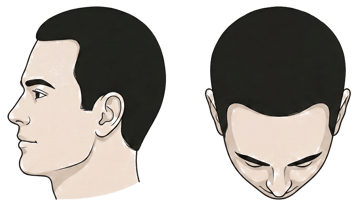
Norwood 1
A full head of hair, no recession
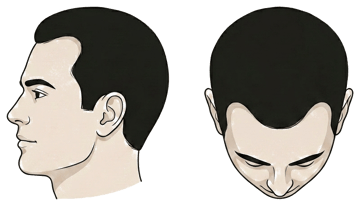
Norwood 2
Slight, even recession at the temples
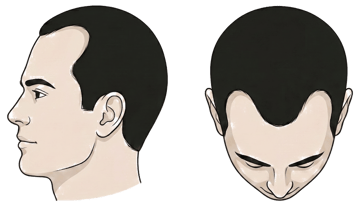
Norwood 3
Deeper M or V recession at the temples
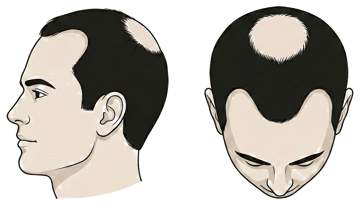
Norwood 3 vertex
M temples plus a thinning crown
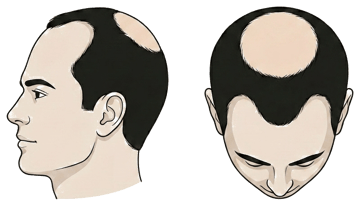
Norwood 4
Hairline further back, a distinct crown patch
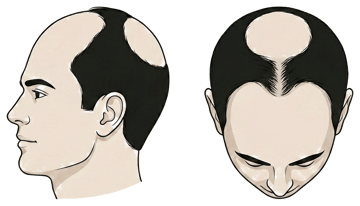
Norwood 5
Larger front and crown, a narrow bridge between
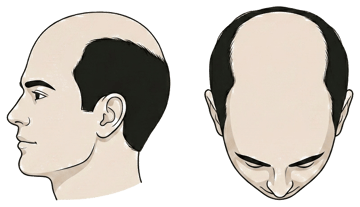
Norwood 6
Front and crown merge, a horseshoe remains
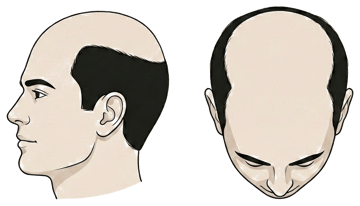
Norwood 7
Only a narrow band around the sides and back
- Stage 1 is a full head of hair with no meaningful recession. This is your baseline.
- Stage 2 is a slight, even recession at the temples, the “mature” hairline most men settle into. It is not yet considered balding, and if you are trying to work out whether you are at stage 2 or heading past it, our guide to telling a mature hairline from a receding one walks through three checks you can do at home.
- Stage 3 is the first stage generally counted as clinically significant loss: the temples recede into a clear M or V shape. In the Stage 3 vertex pattern, the crown starts thinning too, separated from the front by a band of hair.
- Stage 4 has a hairline further back than stage 3, plus a distinct thinning or bald area at the crown.
- Stage 5 is the same picture with larger areas front and back, and a narrower bridge of hair between them.
- Stage 6 is where the front and crown areas merge into one, leaving a horseshoe fringe around the sides and back.
- Stage 7 is the most advanced: only a narrow band of hair remains around the sides and back.
There is also the Type A variant, where the hairline marches back uniformly from front to back without a separate bald spot forming at the crown. It accounts for only around three to four percent of cases, which is why most charts leave it out, but it is worth knowing if your loss does not fit the usual mould.

Why it happens, honestly
For the great majority of men, this pattern is androgenetic alopecia, better known as male pattern baldness. The NHS is clear that this type of loss is permanent and “usually runs in the family”. MedlinePlus Genetics explains the mechanism: it is driven by androgens, chiefly a hormone called DHT, acting on follicles that are genetically sensitive to it because of variations in the AR gene. Those follicles gradually miniaturise, producing finer, shorter hairs each cycle until some stop growing visible hair at all.
It is far more common than most men assume, so if you are on this scale, you have plenty of company. MedlinePlus notes that “more than 50 percent of men over age 50 have some degree of hair loss”, and it can begin as early as the teens. A population study of just over a thousand men found pattern loss in nearly half of men aged 30 to 35, rising past seventy percent by the early forties. None of that makes it feel better in the moment, but it does make it ordinary rather than a personal failing.
It is worth ruling out the usual scapegoats while you are here, too. Hats take most of the blame and deserve almost none of it: see do hats cause hair loss for what the twin studies actually found. And if you are trying to place yourself on this scale because you noticed more hair falling out this autumn specifically, check it is not just normal seasonal hair shedding first, since that clears up on its own within a couple of months.
Your Norwood stage is a starting point for a conversation, not a sentence. What you do about it is still your choice.
What to actually do at each stage
This is the part the stage charts leave out. The scale is only useful if it points you towards a decision, so here is how the options tend to line up. There is no single fix, only routes, and the right one depends more on what you want than on your number.
Early (Norwood 2 to 3). You still have most of your hair, so this is the window where medication has the most to protect. Harvard Health notes that minoxidil and finasteride both need four to six months before you see much, and both only work while you keep using them. They can slow the loss and thicken early thinning, which is a genuine option if you are willing to stay on them.
Middle (Norwood 3 vertex to 5). The crown is balding or the hairline is receding enough to notice. Before anything else, it is worth knowing that the right haircut alone genuinely helps at this stage; our guide to hairstyles for thinning hair covers which cuts reduce scalp show-through by pattern. Medication may still help hold the line, a hair transplant can rebuild density if you have enough donor hair, and scalp micropigmentation can blend the thinning so the scalp shows through less. This is the stage where most men are actively weighing routes against each other, PRP included, and our honest look at whether PRP is worth it is worth reading before you commit to a course of it.
Advanced (Norwood 6 to 7). With loss this extensive, a transplant is limited by how much donor hair remains at the back and sides, so the most reliable cosmetic routes are accepting the horseshoe, or a confident, even shaved look created with SMP. Plenty of men find the shaved look is the most comfortable place they have been in years.
The honest cost and upkeep comparison
No stage chart online gives you real numbers, so here is a straight comparison. Costs for transplants are the UK going rate as of late 2025; ours are our transparent from prices.
| Route | Grows real hair? | Surgery or downtime? | Rough cost and upkeep |
|---|---|---|---|
| Watch and wait | No | None | Free, but the loss continues |
| Minoxidil or finasteride | Yes, while used | None, daily routine | Ongoing and private, reverses if you stop |
| Hair transplant | Yes, your own hair | Surgery, about 1 to 2 weeks | Around £4,800 average, roughly £2,000 to £15,000 |
| Scalp micropigmentation | No, it is cosmetic | None | From £1,000, a top-up every few years |
The transplant figures come from a 2025 UK cost survey that put the average at about £4,820 for 1,500 grafts, with quotes across the market ranging from roughly £1,995 to £15,000 - see our full hair transplant cost breakdown by graft count for the detail. The honest headline the sales pages avoid: the NHS states plainly that “no treatment is 100% effective”, and that finasteride and minoxidil are not routinely available on the NHS, so you pay privately.
Where SMP honestly fits
Scalp micropigmentation is the option the transplant and drug pages tend to bury, or leave off entirely. The AI answers at the top of Google for “norwood scale” do not mention it at all. It is worth understanding because it works differently to everything above.
SMP does not grow hair and does not stop the underlying loss. It recreates the appearance of density or a closely shaved hairline by placing thousands of tiny pigment impressions in the scalp. The NHS lists it among hair-loss options, describing it simply as a “tattoo used to look like short hair”. You can see how the technique works on our scalp micropigmentation page. Practically, it does two jobs depending on your stage: on a thinning crown or hairline it adds the look of density so the scalp shows through less, and on more advanced loss it creates the clean, even look of a fresh shave without the patchiness a bare buzz can leave. For a fuller head-to-head, our guide to SMP versus a hair transplant lays the two side by side.
What we would say at a consultation
Before weighing any of this, get clear on one question: do you want to keep and regrow your own hair, or do you simply want to look less thin? That answer sorts the options faster than your Norwood stage does. If regrowth is the goal, start with the medical routes early. If it is the look you care about, SMP may get you there with no drugs and no surgery. Either way, individual results vary, so we would always look at your hair in person first.
The bottom line
The Norwood scale is a useful map, not a countdown. Knowing your stage tells you which options are realistic: medication has the most to offer early, a transplant and SMP come into their own as loss progresses, and doing nothing is a legitimate choice too. What it cannot do is decide for you, because that comes down to whether you want your own hair back or simply want the thinning to stop showing. The quickest way to a straight answer for your stage, and your goals, is a proper look in person. A free consultation is exactly that, and you can see what SMP costs in the UK or check whether SMP is right for you before you come in.
More from the blog

Autumn Hair Shedding in Men (2026): Normal or Something Else?
More hair in the brush this autumn than usual? For most men that is a normal, temporary seasonal shed, not the start of balding. Here is the honest test to tell the two apart, and what to do either way.

Do Hats Cause Hair Loss? What Actually Thins a Hairline
The hat myth has outlived the evidence. In a study of 92 identical twins, the daily hat wearers had less temple recession than their brothers, not more. So if it is not the cap, what is actually going on up there?

Receding Hairline Treatment: What Really Works (and the Honest Third Option)
Noticing your hairline creep back at the temples? An honest look at every receding hairline treatment, from minoxidil to a transplant, what each really does at the front, and where SMP fits if regrowth is not for you.
Common questions
Is a Norwood 2 balding?
Not really. A Norwood 2 is usually a mature hairline rather than balding: slight, even recession at the temples that most men settle into in their twenties. It is the last stage before what clinicians call clinically significant loss, which is Norwood 3. If your hairline has crept back evenly and then held steady, that is normal maturing. If it keeps moving back year on year, or the crown starts thinning too, it is worth keeping an eye on and getting a proper look.
What Norwood stage is considered balding?
Norwood 3 is generally taken as the first stage of clinically significant balding. That is where the temporal recession deepens into a clear M or V shape, and in the Norwood 3 vertex pattern the crown begins to thin as well. Stages 4 to 7 describe progressively more loss, from a distinct bald patch at the crown through to the horseshoe of hair around the sides and back. Stages 1 and 2 are considered a full or maturing hairline rather than balding.
Is Norwood 4 too late to do anything?
No. Norwood 4 is not too late, it just changes which options make sense. There is still hair to preserve, so medication can help hold the line, and a transplant can rebuild density if you have enough donor hair at the back and sides. If you would rather not commit to daily treatment or surgery, scalp micropigmentation can recreate the look of density among the hair you still have, or the clean look of a closely shaved head. What suits you at Norwood 4 depends on your goals more than your stage, which is exactly what a consultation is for.
Can hair loss stop at Norwood 2?
It can appear to. Plenty of men reach a mature Norwood 2 hairline in their twenties and stay there for years, because pattern loss does not always march steadily up the scale. But the Norwood scale does not predict how fast anyone will progress, and there is no guarantee it has finished. If holding onto your hair matters, the medical treatments work best started early, while there is most to protect, so Norwood 2 is a sensible point to get assessed rather than to assume it is over.
What stage of hair loss is reversible?
None of it is truly reversible, because pattern hair loss is genetic and ongoing, but early thinning is the most treatable. Where follicles are miniaturised rather than gone, minoxidil or finasteride can thicken what is there and slow further loss, though only while you keep using them. Once an area is fully bald the follicles are unlikely to return without a transplant. Scalp micropigmentation does not reverse anything either; it recreates the appearance of density or a shaved look, which is a different way to the same goal of looking less thin.
What age do most men go bald?
There is no single age, but the risk climbs steadily. Pattern hair loss can start in the late teens or twenties, and more than half of men have some degree of it by their fifties, rising to around eighty percent by their seventies. The crown and the hairline are usually where it shows first, which is why so many men first notice it in a photo from above or a receding temple long before the mirror makes it obvious.
Thinking about scalp micropigmentation?
Book a free, no-obligation consultation. We'll talk through your hair openly - no guarantees and no medical claims, just a clear idea of whether SMP is right for you.
Book a free consultation