
From the studio
Mature Hairline vs Receding Hairline: Three Ways to Tell
Most men who panic about their hairline in their twenties are watching a normal shift, not balding. Three honest checks to tell a mature hairline from real recession, and what to do if it is the second one.
If you have started comparing your hairline to photographs from a few years ago, you are in very common company, and there is a decent chance nothing is actually wrong. Almost every man’s hairline moves once in early adulthood and then stops. The problem is that the shift looks identical, in the mirror at least, to the first stage of pattern hair loss. This guide is how to tell the two apart, using checks you can do at home tonight, and what your honest options are if it turns out to be the second one.
The short answer
A mature hairline lifts once from its childhood position, roughly a finger's width, then holds. A receding hairline keeps going. The quickest way to tell them apart is not how high the line sits, it is whether it has moved in the last three years and whether the hair just behind it is all the same thickness. On the Norwood scale, a settled adult hairline is stage 2, which is not classed as balding at all; stage 3, where the temples cut back into deep bare recessions, is the first stage counted as real hair loss. If your line is stable and the hair behind it is even, you are looking at a normal adult hairline and there is nothing to fix.
How do you tell if you have a mature hairline? Do these three checks
Nothing here needs a clinic, an app, or a consultation. It needs about ten minutes and an old photograph.
The three checks
- The photograph check. Find a straight-on picture of yourself from three or four years ago and compare it with one taken today, same lighting, hair dry and pushed back. You are looking for movement, not height.
- The brow crease check. Raise your eyebrows and find the top crease on your forehead. A settled adult hairline usually sits a short distance above it, on the order of a finger's width.
- The evenness check. Look closely at the hair in the couple of centimetres just behind your hairline. Every hair roughly the same thickness is reassuring. A mix of thick hairs and noticeably fine, wispy ones in the same patch is not.
The photograph check is the one that actually settles it, and it is the one people skip because they would rather not look. Hair loss is far too slow to see day to day, so the mirror is close to useless for this. Three years of gap is enough to make real movement obvious, and enough to prove that a settled hairline has genuinely settled.
The brow crease check is the folk version of something real. Norwood’s classification, the standard grading system for male hair loss, puts the normal adult hairline a modest distance above the upper brow crease, in the region of one to two centimetres depending on whose description you read. It is a guide rather than a measurement you should trust to the millimetre, because foreheads genuinely differ. You will also see a “four finger rule” doing the rounds online, which is far looser still. A tall forehead can fail it with a perfectly healthy hairline.
The evenness check is the one almost nobody tells you about, and it is the most useful of the three. Dermatologists diagnosing early pattern loss do not primarily look for thin hair, they look for variation in hair thickness, which has the technical name anisotrichosis. A 2024 systematic review of trichoscopy in androgenetic alopecia found hair diameter diversity of 20% or more is used as a diagnostic criterion in men, and that this variability was present in 99.81% of men with the condition. DermNet lists it alongside vellus hairs as a key indicator. In plain terms, that is why the evenness check works.
Pattern hair loss does not begin as thinner hair. It begins as uneven hair.

What is a mature hairline?
The hairline you had as a child sits low and runs almost straight across the forehead. Somewhere between the late teens and the early thirties it lifts to its adult position, typically taking on a slight M or V shape as the corners at the temples pull back a little further than the middle. Then it stops. That is the whole event.
The key features, then, are these:
- Position. It sits roughly a finger’s width, about one to two centimetres, above the crease that appears when you raise your eyebrows.
- Shape. It moves back evenly, in a mild and symmetrical M or V, with no deep notch on one side.
- Thickness. The hair immediately behind the line stays uniform, with no fine, wispy hairs mixed among the thick ones.
- Stability. Once it reaches the adult position, it stops. That is the defining feature.
On the Norwood scale, the seven stage system used to grade male hair loss, this settled adult hairline is stage two, and stage two is explicitly not classed as balding. It is the last stage before hair loss is recognised at all.
So when is it actually receding?
The difference is not really about how far back the hairline sits. It is about movement and texture. It helps to see where the two sit on the Norwood scale, because the boundary between them is the step from stage 2 to stage 3.
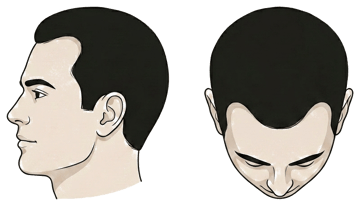
Norwood 2
The mature hairline: slight, even temple recession, not balding
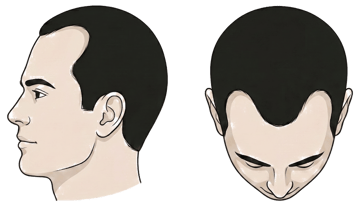
Norwood 3
Early recession: deeper M or V notches at the temples
Here is the same comparison in full.
| What to look at | Mature hairline | Receding hairline |
|---|---|---|
| Movement | Lifts once, then holds its position | Keeps moving back over years |
| Shape | Even, symmetrical, mild M or V | Deep, often uneven notches at the temples |
| Hair behind the line | All roughly the same thickness | Thick and fine hairs mixed in the same patch |
| Crown | Unaffected | Often thinning at the same time |
| Norwood stage | Stage 2, not classed as balding | Stage 3 and beyond |
| What to do | Nothing | Decide whether you want to act, and when |
That last row is the honest one. Every page you will find on this subject is run by somebody selling a transplant, a tablet or a laser device, so almost none of them will tell you that the correct response to a mature hairline is to do nothing at all. It usually is.
The crown row matters more than people expect. A hairline drifting back on its own is ambiguous. A hairline drifting back while the crown thins is the classic pattern, and it is worth reading our guide to crown thinning if you have noticed both.
Why does a hairline move at all?
Male pattern hair loss is genetic and hormonal. MedlinePlus, the US National Library of Medicine’s reference, describes it as loss in “a well-defined pattern, beginning above both temples”, with the hairline receding into a characteristic M shape and the crown thinning separately. The driver is an androgen called dihydrotestosterone, or DHT, acting on receptors produced by the AR gene. Follicles that are sensitive to it run progressively shorter growth cycles and push out finer hair each time, which is precisely why thickness becomes uneven before anything looks bald.
The enzyme behind it is 5-alpha-reductase, which converts testosterone into DHT. As one review in the Postgraduate Medical Journal puts it, DHT binds to the same receptor as testosterone “but fivefold more avidly”. That same review sets out how common it is: around 30% of men have androgenetic alopecia by the age of 30, and 50% by the age of 50. MedlinePlus agrees, noting more than half of men over 50 have some degree of loss and that it can begin as early as the teens.
That number is worth sitting with. If half of all men are affected by 50, a changed hairline is not a personal failing or a sign you did something wrong. It is the most ordinary thing that happens to men’s hair.
When it is not pattern loss at all
The checks above are for the slow, symmetrical, patterned kind. Hair that falls out suddenly, comes out in a distinct round patch, or is accompanied by an itchy, sore or scaly scalp is a different matter entirely and is not something a cosmetic studio should be advising you on. See your GP. The same goes for hair loss after illness, a big weight change or serious stress, which is often temporary and recovers on its own.
If it is receding, what actually works?
Take your time here. A receding hairline is not an emergency and the worst decisions in this field are made in a hurry. There are four honest routes, and we only offer the last one.
Do nothing. Genuinely an option, and the one plenty of men land on. Loss is slow, and a shorter cut suits a higher hairline better than most people expect.
Medication. Minoxidil and finasteride are, in the NHS’s words, “the main treatments for male pattern baldness”. The NHS is equally blunt about the limits: they “do not work for everyone”, they “only work for as long as they’re used”, and “no treatment is 100% effective”. The Postgraduate Medical Journal review gives the numbers behind that. At twelve months on minoxidil, 15% saw medium regrowth, 50% had their loss delayed and 35% carried on losing, and on stopping, “all these new hairs are shed”. Finasteride did better, with 48% seeing regrowth and 51% stabilising. Worth knowing before you start, since the honest deal is that these are indefinite commitments, and most of it is not funded on the NHS.
A hair transplant. Real surgery, and the only route that puts growing hair back at the front. The NHS puts the UK cost at between £1,000 and £30,000 and states plainly that it is “not available on the NHS because it’s cosmetic surgery”. It also flags the thing clinics tend to underplay: “your hair might continue to thin around the transplant”, along with risks including infection, transplant failure and noticeable scarring. When we looked at the pricing published by the UK clinics ranking for hair transplant costs in July 2026, their own quoted ranges sat between roughly £2,500 and £20,000, depending on graft numbers.
Scalp micropigmentation. What we do. It puts no hair back, and we would rather say that first.
Where SMP honestly fits
Scalp micropigmentation settles tiny points of matched pigment into the upper layers of the skin, each one sized and shaded to read as a hair follicle. The NHS lists it among hair loss options and describes it accurately as a “tattoo used to look like short hair”. That description is the honest limit of it. It recreates the appearance of a hairline or of density. It does not grow hair, and it does not slow down what is happening underneath.
Where it earns its place is when the hair has genuinely gone and you want the look of a sharp, closely shaved hairline back, or when thinning has left too much contrast between hair and scalp and you want that softened. A full SMP treatment starts from £1,000 and density work from £600, with everything set out on our prices page. It lasts around three to seven years before it softens enough to want refreshing, and individual results vary.
Where it does not earn its place is on a hairline that has simply matured. If your line has settled and the hair behind it is even, there is nothing for us to correct, and we will tell you that rather than take the booking. If regrowth at the front is what you are really after, our guide to receding hairline treatments covers those routes properly.
The bottom line
Go and find that old photograph. If the hairline has not moved in three years and the hair behind it is all one thickness, you have a mature hairline, and the right thing to do about it is nothing. If it has kept moving, or the thickness has gone patchy, then you know what you are dealing with and you have time to decide what, if anything, you want to do. The one thing worth avoiding is spending money on a problem you have not confirmed you have.
If you would like someone to look properly, we do free consultations in Haverhill, in person or by video, and we are perfectly happy to tell you that you do not need us.
More from the blog

Hair Transplant Scars: Your Honest Options for Hiding Them
Every hair transplant leaves a scar, an FUT strip line or scattered FUE dots. Here is the honest rundown of what makes them show, the options for reducing them, and where non-surgical SMP camouflage fits.
Do Hair Fibres Actually Work? An Honest Guide (and How They Compare to SMP)
A £20 pot of hair fibres is the cheapest thing to try for thinning hair, and for a lot of people it genuinely works. Here is what fibres do well, where they let you down, and when SMP is the better long-term answer.

What a Hair System Really Costs in the UK (Over Five Years, Not One)
Salon price lists quote one unit. Nobody adds up the refits, the replacements and the tape. So I did, using the published prices of real UK salons, and the five-year number is the one worth knowing before you start.
Common questions
What age is a mature hairline?
Usually somewhere between the late teens and the early thirties. The hairline you had at fourteen sits low and rounded across the forehead, and at some point in early adulthood it lifts to its adult position and settles there. Most men see it happen in their twenties. There is no fixed age, and starting earlier does not mean anything is wrong. What matters far more than when it moved is whether it has stopped moving since.
What is the four finger rule for hairline?
It is a rough self-check, not a medical test. The idea is that you hold four fingers stacked above your eyebrows, and if your hairline sits higher than that, it may be receding rather than simply mature. Treat it as a very loose guide. Foreheads genuinely differ in height, so a tall forehead can fail the test with a perfectly stable hairline while a low one can pass it while quietly receding. The Norwood classification uses a much smaller distance, roughly a finger's width above the crease that appears when you raise your eyebrows, to mark the normal adult hairline. Either way, a single measurement taken once tells you far less than whether the line has moved over two or three years.
Is a mature hairline good or bad?
It is neither, it is just what an adult hairline looks like. On the Norwood scale, the stage that describes a mature hairline is not classified as baldness at all. The first stage that clinicians recognise as clinically significant balding is the one after it, where the temples cut back into deep, bare recessions. So a hairline that has lifted evenly and then held its position is not the beginning of anything. It is the end of a normal change.
Is a mature hairline attractive?
That is a matter of taste rather than something anyone can answer for you, and it is worth remembering how ordinary it is. A mature hairline is simply the adult version of the one you had as a teenager, and the great majority of men settle into one. It is not a sign of hair loss, it is not classed as balding, and it does not mean anything is wrong. Most of the anxiety we hear about hairlines is about the fear of what might come next rather than about the line itself, which is exactly why it is worth establishing whether yours is stable before worrying about how it looks.
How do you style a mature hairline?
As general grooming rather than anything clinical, a few things tend to work. Shorter cuts usually sit better with a higher hairline than a heavy fringe pushed forward, because a fringe draws the eye straight to the line you are trying not to advertise. Textured, slightly messy styles soften the corners at the temples, whereas a hard side parting or anything slicked flat tends to emphasise them. Keeping a little length on top adds the impression of volume. Plenty of men also find that once the hairline has settled, simply going shorter all over stops it being something they think about at all.
How fast does a receding hairline move?
Slowly, and unevenly, which is what makes it so hard to judge. Pattern hair loss is a gradual process measured in years rather than months, and it often stalls for long stretches before shifting again. That is why comparing today's hairline to a photograph from three or four years ago is far more reliable than staring at it daily. If you genuinely cannot tell from old pictures, a dermatologist can look at the hair under magnification and get an answer in minutes.
Can you have SMP on a mature hairline?
Usually we would tell you not to bother, and we say so at consultations fairly often. If your hairline has settled into its adult position and the hair behind it is healthy and even, there is nothing there to correct, and adding pigment to a hairline that is not receding tends to look like exactly that. Scalp micropigmentation earns its place when there is a real loss of density or a hairline that has genuinely retreated and is not coming back. If you are unsure which camp you are in, that is a sensible thing to have someone look at before you spend anything.
Thinking about scalp micropigmentation?
Book a free, no-obligation consultation. We'll talk through your hair openly - no guarantees and no medical claims, just a clear idea of whether SMP is right for you.
Book a free consultation