
Winter 2026
Bald Head Care in Winter (2026): A 6-Step Routine, Dry Scalp and Your SMP
Three questions come up in the chair at this time of year: why has my head gone dry and flaky, is it dandruff, and is the cold doing anything to my SMP? Here is what the evidence says, and where it runs out.
In short
Bald head care in winter comes down to looking after the skin barrier: wash with lukewarm water, put a plain unperfumed moisturiser on straight after while the skin is still damp, and treat itchy flaking that will not settle as possible dandruff, with an anti-dandruff shampoo. You do not need a bald-care range, and daily sunscreen matters far less in a UK December than in summer. If you have SMP, there is no evidence that cold affects the pigment. A dry, flaky scalp may just make it look duller for a while.
Three questions come up in the studio at this time of year. Why has my head gone dry and flaky? Is it dandruff? And is the cold doing anything to my SMP?
The first two apply to anyone with a shaved head, whether or not they have ever sat in my chair. The third is for anyone with, or thinking about, scalp micropigmentation (SMP), which the NHS describes as a tattoo used to look like short hair: does the cold affect SMP, and is winter a good time to start. I will answer all three, and say where the evidence is solid. On one of them there is none at all.
Bald head care in winter: a six-step routine
A good winter routine for a shaved head is six habits: short lukewarm washes, a soap-free cleanser, moisturiser straight after, the right shampoo only if it is dandruff, a gentle shave, and a loose, clean hat. None of it needs a special product.
- Wash with lukewarm water, and keep it short. The NHS advice for itchy skin is cool or lukewarm showers and not spending long in them, and DermNet says the same: “Use lukewarm water, not hot water.”
- Swap soap and shower gel for a gentle soap-free wash. The NHS points out that “everyday soaps, shampoos and shower gels usually dry out the skin”, and the BAD recommends a gentle soap-free wash.
- Pat dry, then moisturise straight away. The NHS says an emollient “should be applied as soon as you have patted your skin dry”, smoothed in the direction the hair grows to avoid blocking the follicles. Unperfumed is best. DermNet adds that moisturisers with a humectant such as urea work well on damp skin. Skip aqueous cream: the NHS no longer recommends it because one of its ingredients can irritate.
- If it is dandruff, use the right shampoo properly. The BAD names zinc pyrithione, selenium sulphide and ketoconazole, and the NHS adds coal tar and salicylic acid. Lather it on and leave it for five to ten minutes before rinsing, as the BAD suggests. The NHS says to give it up to four weeks, but to see a GP sooner if your scalp is red or swollen, very itchy, or you have flaky patches on your face or body. How to tell dandruff from dryness is the next section.
- Shave kindly. Shave with the grain, use a sharp blade and wet the skin with warm water first. The NHS on ingrown hairs also suggests leaving at least 1mm of stubble if you can. I have gone through the rest of the shaving advice in the shaved head and beard guide.
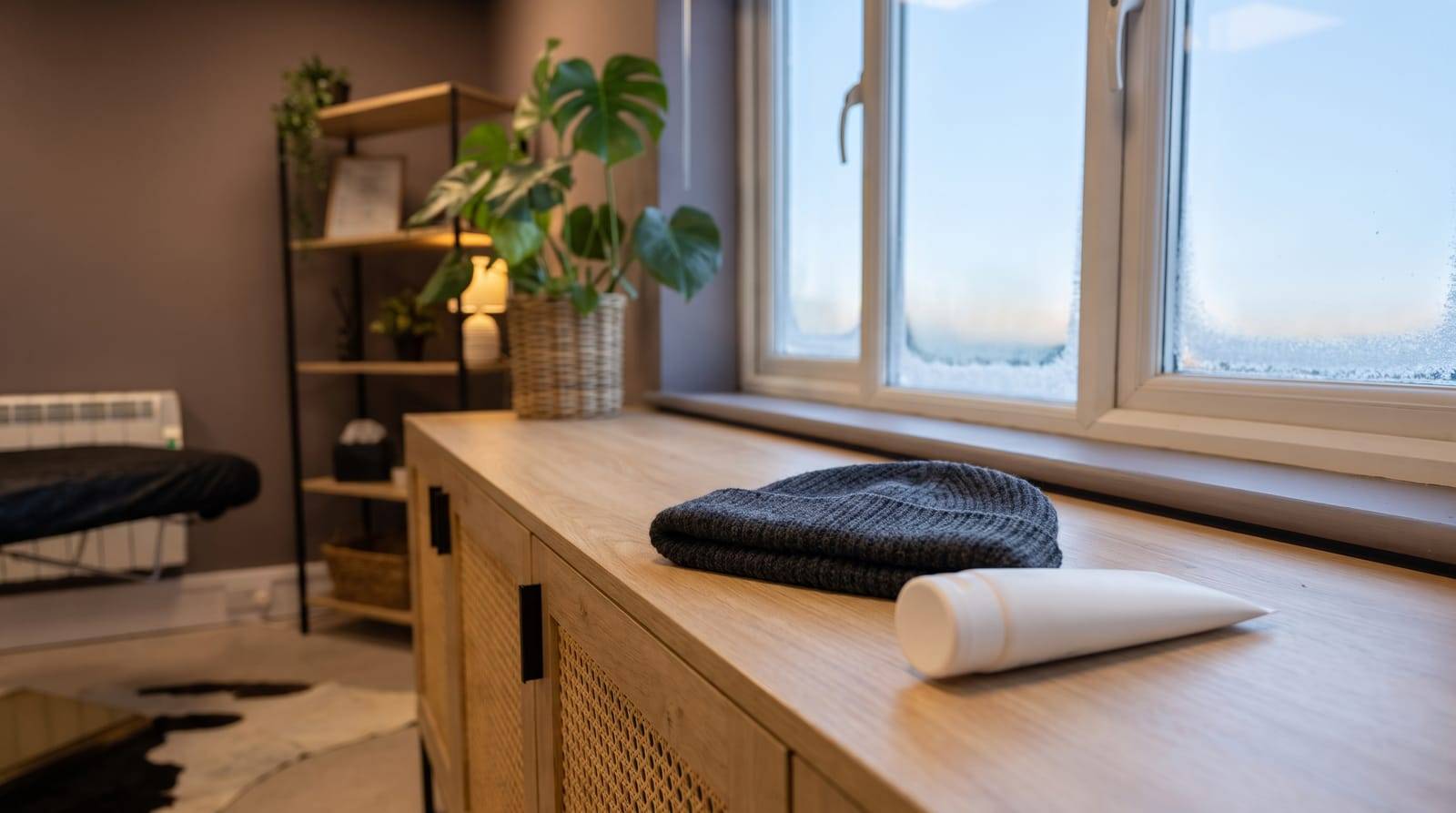
- Keep hats loose and clean. A tight beanie over a freshly razored scalp is friction plus trapped sweat, and DermNet lists occlusion and friction from tight clothing among the things that set off folliculitis. It does not name hats, but the logic carries.
Sun cover sits alongside these steps rather than in them: check the UV index on bright days, and on snow use SPF 30 or higher with at least 4-star UVA protection, or a wide-brimmed hat. The full sunscreen answer is further down. And there is no good evidence that hats cause hair loss either: I looked at that in do hats cause hair loss.
If you sleep cold, you are not alone. A UK poster on r/CasualUK bought “a very lightweight merino wool beanie for sleeping in through the winter as I was getting killer headaches from my scalp getting cold over night”. A clean, loose hat is unlikely to be the problem. Going by what DermNet says about friction and trapped sweat, a tight one worn all day is the more likely culprit.
Can shaving your head cause ingrown hairs?
Yes. The NHS says you are more likely to get ingrown hairs in areas you shave, and DermNet says razor bumps can occur on any site where hair is shaved. Neither gives a figure for how common they are on a shaved head specifically, so I will not invent one.
Dry skin or dandruff? How to tell on a shaved head
Shaving your head does not cure dandruff, because dandruff is a skin condition, not a hair problem. And the honest answer to “which is it” is that you often cannot tell by eye: both flake, and both can itch. There are clues, though, and they need different fixes.
| What you notice | What it might be | What helps |
|---|---|---|
| Dull, rough, scaly skin, worse after hot showers and soap | Dry skin | Lukewarm water and a plain moisturiser straight after washing |
| White flakes and an itchy scalp, often worse in cold weather | Dandruff | An anti-dandruff shampoo used as a scalp wash, for up to four weeks |
| Scaly, itchy, red patches, sometimes on the face too | Seborrhoeic dermatitis | A GP, which the NHS advises for a red or swollen scalp or patches on your face |
| Red, flaky, crusty, sore patches covered with silvery scales | Possibly psoriasis | A GP appointment, because it needs diagnosing |
| Small bumps or sore spots after shaving | Razor irritation or ingrown hairs | A gentler shave, as in step 5 above |
The table draws on the NHS dandruff page, which lists the look-alikes, DermNet’s guides to dry skin, seborrhoeic dermatitis and scalp psoriasis, and MedlinePlus. It is a guide to what is likely, not a diagnosis.
DermNet describes dandruff as an uninflamed form of seborrhoeic dermatitis, linked to a yeast called Malassezia that lives on everyone’s skin. The British Association of Dermatologists says it affects almost half of all adults, that seborrhoeic dermatitis is slightly more common in men, and that flares can be “triggered by tiredness, stress and cold, dry weather”.
Winter makes it worse. In the Rotterdam Study, a population study of almost 5,500 people, men had about twice the odds of seborrhoeic dermatitis and the odds were lower in summer than in winter. A study of more than 90,000 skin clinic patients in Istanbul found 35% of cases in winter against 14% in summer. The NHS puts it simply: “Stress and cold weather may also make dandruff worse.”
Can you tell if dandruff is fungal?
Not reliably by eye. The yeast behind dandruff lives on everyone’s skin, and the BAD says seborrhoeic dermatitis can be hard to tell apart from other rashes. White flakes with an itchy scalp are what the NHS describes for dandruff, a pharmacist can advise, and the NHS says to see a GP if four weeks of anti-dandruff shampoo has not helped. DermNet also notes that some strains of the yeast resist ketoconazole, and suggests zinc pyrithione or selenium sulphide instead.
What I would steer you away from is treating plain dryness with dandruff shampoo. Those shampoos are made for dandruff, and the azole ones such as ketoconazole work on the yeast, not on missing moisture. One r/bald poster put it bluntly: “The dandruff shampoo will make your scalp drier btw, it is meant for fungal dandruff not simple dryness.” If it is dryness, moisture is what your scalp is missing.
Why does a shaved head get so dry in winter?
Cold air, low humidity and central heating all pull water out of the skin’s outer barrier, and a shaved scalp has no hair over it to shelter it. As one poster on Reddit’s r/CasualUK put it: “Being bald in winter is another level of cold.”
A review in the Journal of the European Academy of Dermatology and Venereology concluded that “low humidity and low temperatures lead to a general decrease in skin barrier function”, and singled out northern Europe’s winters for dry, itchy skin. DermNet and MedlinePlus list the same culprits: cool, windy weather, dry indoor heating, direct heat from a fan heater, and bathing too often or too long.
When researchers compared winter and summer skin, the damage to the barrier was much larger on the face than on the forearm, the face being the part left out in the weather. Nobody has measured a bald scalp the same way, but a shaved head is exposed in exactly the way a face is. Add the winter routine most of us have, wind outside, a heater in the car, a radiator at home and a long hot shower to warm up, and each step takes a little more moisture out.
So the fixes are the first three steps above, plus one more habit: do not sit with a fan heater blowing straight at your head, because DermNet lists direct heat from a fire or fan heater among the causes of dry skin.
Do you need sunscreen on a bald head in winter?
Not every day, but check rather than assume. The NHS and Cancer Research UK suggest protecting your skin when the UV index is 3 or higher, which your weather app shows, and on snow you should cover up properly.
Bald-care routines usually just say to wear SPF, without saying when UK sun is actually strong enough to matter. Cancer Research UK says the sun “is often strong enough to cause damage in the UK between mid-March and mid-October”, and the Met Office talks of spring UV being “higher than we’ve been used to over winter”. On a bright winter day, the UV index is the thing to check.
Snow is different. The Met Office says it reflects about 85% of the sun’s UV rays, which is why people burn in alpine resorts in freezing weather. If you are skiing this winter, the NHS advice applies in full: SPF 30 or higher, at least 4-star UVA protection, on your head if you have thinning or no hair. The NHS also says a wide-brimmed hat is better than sunscreen alone.
It is worth caring about over the years. The BAD lists “any scalp areas without hair” among the usual places for sun-damaged patches called actinic keratoses, and in the Rotterdam Study bald men had seven times the odds of extensive sun damage. I have covered summer sun in the guide to shaving your head when balding.
In a UK December, a bald head's biggest enemy is the radiator, not the sun.
Three questions about SMP in winter
These come straight from the chair. There is no research at all on scalp micropigmentation, or tattoos generally, in cold weather. So the answers below are built from what is known about where the pigment sits, what fades it, and what winter does to skin. Where I am reasoning rather than quoting a study, I will say so.
Does the cold affect SMP?
There is no evidence that it does. Healed SMP pigment sits in the upper and middle layers of the dermis, below the skin’s surface. A clinicopathological study of scalp micropigmentation puts it in the “upper and midpapillary dermis”, and research on tattoo pigment in mice shows it is held inside immune cells that capture and recapture it over time. Healed pigment sits below the surface, so there is no obvious route for air temperature to reach it.
The things known to fade it are sunlight, which the International Society of Hair Restoration Surgery says “will fade scalp micropigmentation pigments more quickly than otherwise”, slow clearance by the body over the years, and treatments that injure the skin such as laser or strong peels. Cold is not on the list. If anything, a UK winter is a gentle season for SMP, because the sun is weaker. I have written about how long scalp micropigmentation lasts if you want the full picture.
Does winter change how SMP looks?
It can, through the skin on top rather than the pigment underneath. DermNet describes dry skin as having “a dull surface with a rough, scaly quality”. A study of skin moisturisation found that dried-out skin scatters more light at its surface, while moisturised skin becomes more translucent and lets light through to the layers below.
Put those together and a dry winter scalp can make the dots read slightly softer and paler, then crisper again once the skin is moisturised. That is my reasoning from the skin research. Nobody has measured it on SMP. Flakes can sit over the pigment, but they cannot take healed pigment with them: the same study of SMP notes that only pigment left in the top layer of skin is “exfoliated with the stratum corneum and washed away”.
What should I use on a dry scalp with SMP, and what should I avoid?
Use the same routine as above: lukewarm water, a plain unperfumed moisturiser straight after washing, and SPF when the sun is strong. That matches our own long-term aftercare: light moisturising, and SPF on the bare scalp whenever you are out in real sun.
Avoid harsh scrubs, and be wary of strong or at-home peels. An NHS hospital leaflet on medical tattooing warns that chemical peels over micropigmentation “may change the colour”, and a 2025 paper by US Food and Drug Administration authors warned that people using chemical peels at home without professional guidance can injure their skin, with lasting effects. Leeds Teaching Hospitals advises avoiding retinol for four weeks after medical tattooing. Evidence that retinol fades a fully healed result over the long term is thin, but there is no reason to rub it into your scalp.
Dandruff shampoo is the awkward one. The NHS lists salicylic acid as a dandruff treatment, and I have not found any research on whether it affects healed SMP, though at least one clinic warns against it. Ketoconazole and zinc pyrithione do not contain salicylic acid, but I have not found research on them and SMP either. So the advice is the same whichever you use: treat the dandruff, and tell me what you are using.
What I would say in the chair
If your scalp is dry, moisturise it. If it is dandruff, treat it properly, with a pharmacist's help, and tell me what you are using so we can keep an eye on it together. Neither one is a reason to scrub. And if your SMP is still healing, follow your aftercare sheet first: the SMP advice in this post is for a fully healed scalp.
One r/SMPchat poster, a month out from treatment, wrote: “I get nervous to exfoliate my scalp as if it will affect the treatment.” That caution makes sense. For a dry scalp, moisture is the fix, and DermNet lists abrasives among the things that make dry skin worse. Our guide to what to expect covers the healing weeks in detail.
Is winter a good time to have SMP done?
For most people, yes, and the reason is the sun. Fresh SMP needs protecting from strong sunlight while it heals, and Cancer Research UK puts damaging UK sun between mid-March and mid-October, so a winter start means less sun while the work heals. Bright winter days and any ski trip are still worth covering up for.
Most treatments here take two or three sessions spaced two to four weeks apart. Start in November, December or January, and the course is usually finished and healed well before spring. The things to plan around are the ones in our aftercare: hats that rub in the first days, saunas and heavy sweating straight after each session, and any skiing trip while you are still healing.
The NHS describes micropigmentation plainly as a “tattoo used to look like short hair”. It recreates the appearance of a close shave, it does not grow hair or stop the loss underneath, and individual results vary. Full SMP starts from £1,000 and density SMP, for thinning rather than bald areas, from £600. You can read more about scalp micropigmentation and see real results, or book a free consultation to plan the timing around your own winter.
If you only do three things this winter
Turn the shower down from hot to lukewarm. Moisturise straight after, while your scalp is still damp, with something plain and unperfumed. And if flaking and itching do not settle, treat it as possible dandruff rather than piling on more moisturiser, because the two need different fixes.
If you have SMP, there is no evidence that the cold is fading it. A dry scalp may make it look tired, and it may look crisper again once it is moisturised. Keep an eye on the UV index on bright days, cover up properly on snow, and if your scalp turns red or sore, or the flaking has not settled after a month, see a pharmacist or your GP. It might be something that needs treating properly.
Common questions
What should I put on my bald head in winter?
A plain, unperfumed moisturiser, put on straight after you wash while the skin is still slightly damp. That is NHS advice for emollients generally: apply as soon as you have patted the skin dry, and smooth it in the direction the hair grows. DermNet adds that moisturisers containing a humectant such as urea work well on damp skin. You do not need a product sold specifically for bald heads. What matters more is washing with lukewarm water rather than hot, keeping showers short, and swapping ordinary soap or shower gel for a gentle soap-free wash, because everyday soaps tend to dry the skin out.
Is it dandruff or dry skin on a shaved head?
Often you cannot tell by eye, because both flake and both can itch. Dry skin tends to look dull, rough and scaly, and it gets worse with hot water and soap. The NHS describes dandruff as white flakes with a scalp that may feel dry and itchy, and says cold weather can make it worse. It is a mild, uninflamed form of seborrhoeic dermatitis, linked to a yeast that lives on everyone's skin. An anti-dandruff shampoo is the NHS first step, for up to four weeks, but see a GP sooner if your scalp is red or swollen, very itchy, or you have flaky patches on your face or body.
Can you use anti-dandruff shampoo on a bald head?
Yes. Dandruff is a condition of the skin, not the hair, so shaving does not get rid of it, and a medicated shampoo works as a scalp wash with or without hair. The British Association of Dermatologists names zinc pyrithione, selenium sulphide and ketoconazole, and suggests leaving the lather on for five to ten minutes before rinsing, then using it once or twice a week once the scalp is clear. The NHS lists ketoconazole, coal tar and salicylic acid. These are treatments made for dandruff. They are not the fix for a scalp that is simply dry, which needs moisturising instead.
Do I need sunscreen on my bald head in winter?
Not every day, but check rather than assume. Cancer Research UK says the sun is often strong enough to cause damage in the UK between mid-March and mid-October, and both the NHS and Cancer Research UK suggest protecting your skin when the UV index is 3 or higher, which any weather app will show you. Snow is the big exception: the Met Office says it reflects about 85% of the sun's UV, so a skiing trip is exactly when a bare scalp burns. When you do need protection, the NHS advice is SPF 30 or above with at least 4-star UVA, and it says a wide-brimmed hat is better still.
Does cold weather affect scalp micropigmentation?
There is no evidence that cold affects the pigment itself, and also no research on SMP in cold weather at all, so we would not claim more than that. Healed scalp micropigmentation sits in the dermis, below the surface layer of skin, held inside cells. The things known to fade it are sunlight, slow natural clearance by the body over years, and treatments that injure the skin such as laser or strong peels. What winter can change is the skin on top. Dry skin scatters more light and looks duller, so our reading of the skin research is that the work can look softer until the skin is moisturised again, though nobody has measured that on SMP.
Is winter a good time to get scalp micropigmentation?
For most people it is a good time, mainly because of the sun. Fresh SMP needs protecting from strong sun while it heals, and Cancer Research UK puts damaging UK sun between mid-March and mid-October, so a winter start means less sun while the work settles. Bright winter days and any ski trip are still worth covering up for. A course of two or three sessions, a few weeks apart, started in November to January is usually healed well before spring. Plan around hats that rub and saunas or heavy sweating in the first days after each session. Your free consultation is the place to plan the timing.
Thinking about scalp micropigmentation?
Book a free, no-obligation consultation. We'll talk through your hair openly - no guarantees and no medical claims, just a clear idea of whether SMP is right for you.
Book a free consultationMore from the blog
Correcting Poorly Executed Scalp Micropigmentation: Russ's SMP Transformation
Russ paid £350 for about an hour of SMP at another studio and came away with oversaturated, uneven work. This is how I corrected it over four sessions without laser, with his real photos, the price and the honest limits.
How Long Does Scalp Micropigmentation Last? The Honest Timeline
Every SMP page says three to six years and stops there. Here is the actual reason pigment fades, the factors that genuinely speed it up, and an honest answer on when you will want a touch-up.
Density SMP Treatment After One Session
A first density SMP session can already soften the contrast between hair and scalp on thinning areas, but a natural, settled result is built gradually. Here is a realistic look at what one session can and cannot do.