
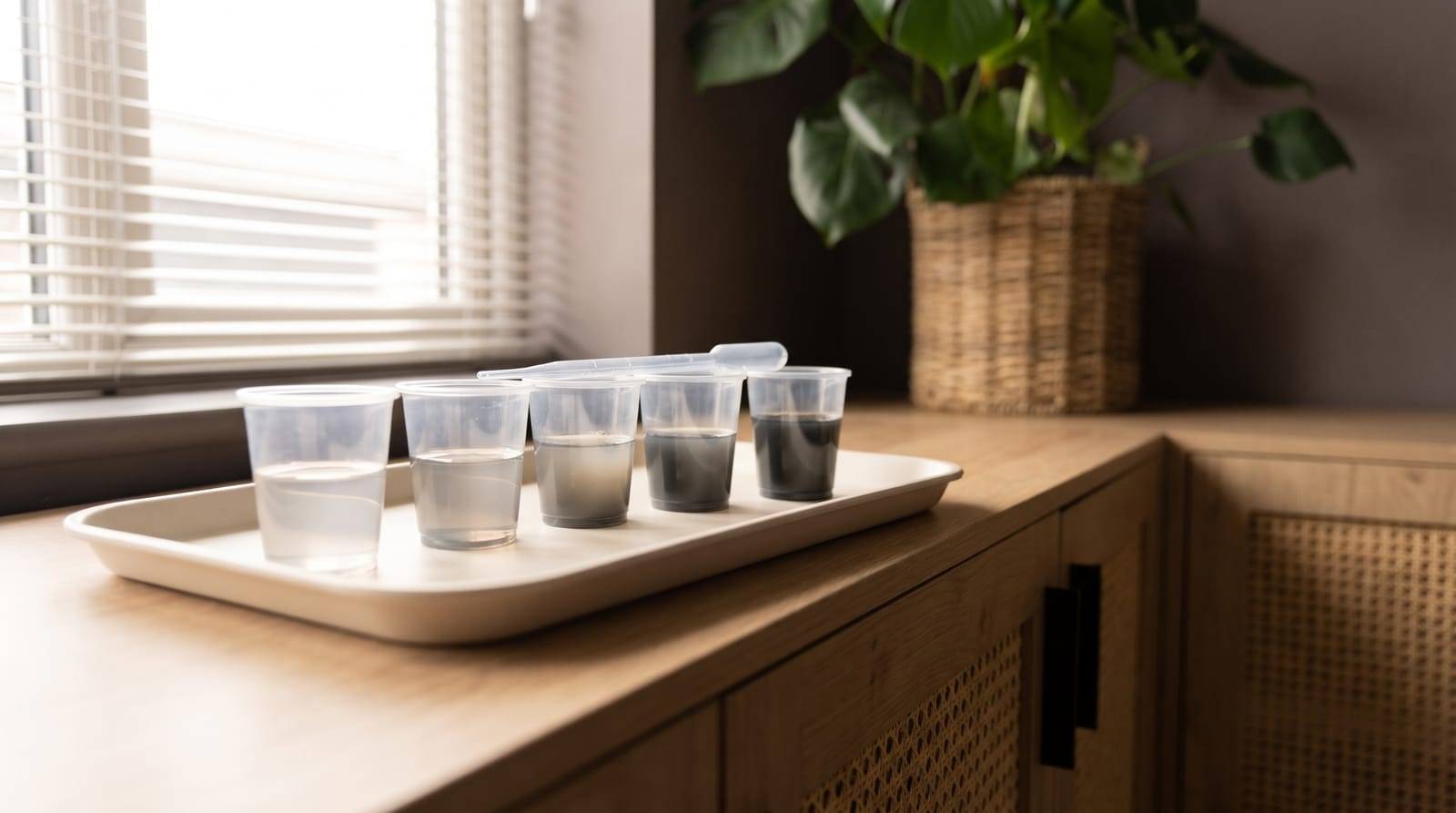
A real corrective case
Correcting Poorly Executed Scalp Micropigmentation: Russ's SMP Transformation
Russ paid £350 for about an hour of SMP at another studio and came away with oversaturated, uneven work. This is how I corrected it over four sessions without laser, with his real photos, the price and the honest limits.
In short
Often, yes. Uneven, patchy or oversaturated SMP can usually be evened out by adding fine new pigment around it over several sessions, as Russ's was over four. Correction can only add pigment, though: blown-out dots can be blended in but never made smaller, so laser comes first when you want them gone.
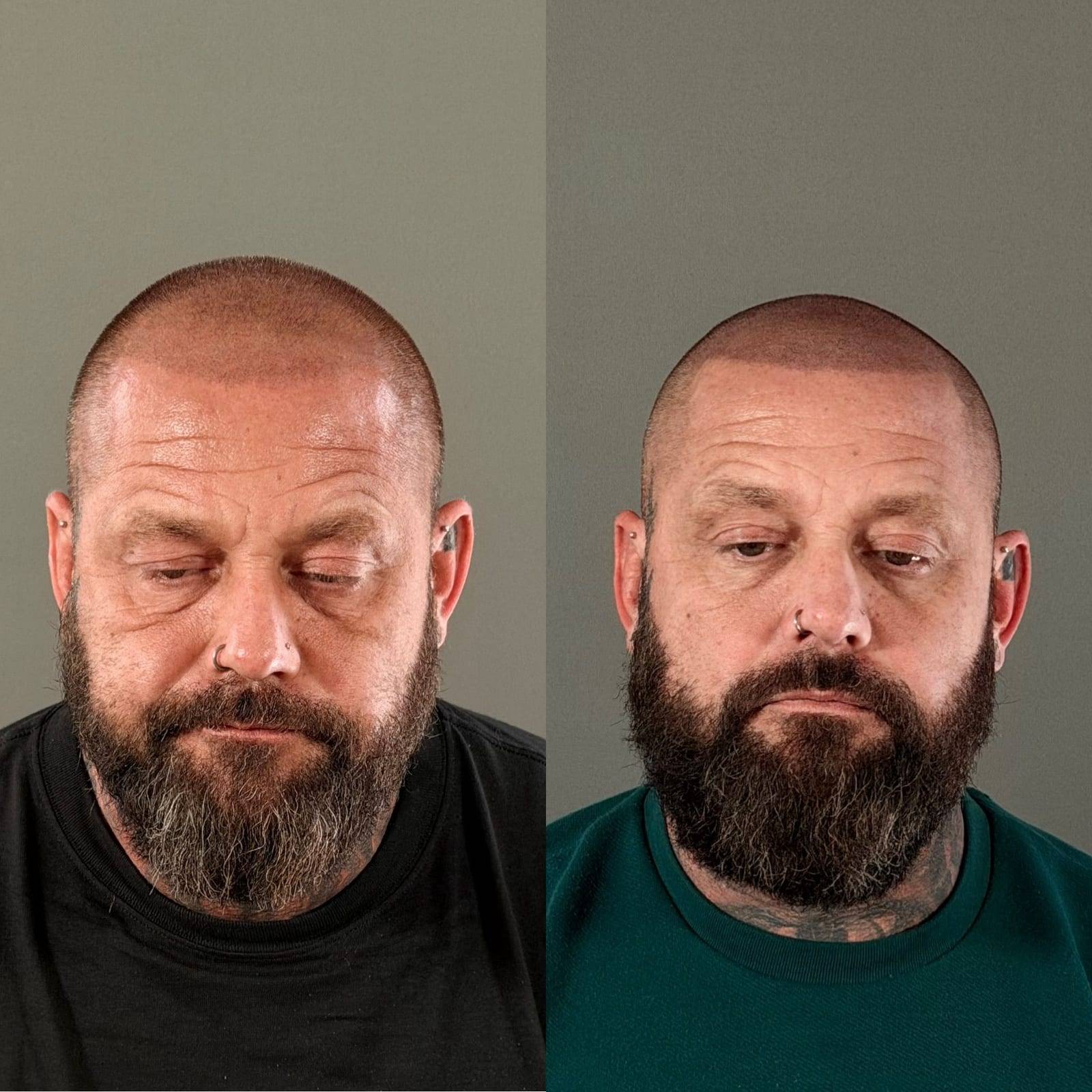
Russ came to me at Kennedy SMP Studio in Haverhill having already had scalp micropigmentation somewhere else. He had paid £350 and received roughly an hour of treatment, and he was not happy with what he had been left with. He wanted to know whether anything could be done.
This is his case, start to finish, in more detail than I would normally go into: what was wrong, why I did not reach for laser, how the four sessions were spaced, what it cost, and where the limits of correcting someone else’s work really are. Russ has kindly let me use his name and his photos. If you are reading this because your own SMP has not turned out the way you were promised, I hope it gives you a clearer picture of your options, and if you would rather someone looked at yours, a free consultation is the quickest way to find out what can be done.
What Russ came in with
The problem was not a lack of pigment. Parts of his scalp were oversaturated, with far too much pigment packed into them, and the individual impressions varied considerably in size and appearance. There were signs of inconsistent implantation depth and areas of pigment blowout, where the dots had spread and blurred into each other. The overall finish was uneven, with some areas noticeably darker and less natural than others.
Those faults have well understood causes. The International Society of Hair Restoration Surgery explains that if pigment goes in too deep, it “will spread in the fat and oils, leading to significant and blotchy discoloration”. A 2025 technical review in the Journal of Cosmetic Dermatology puts blurring down mainly to applying too much pigment in one area, and warns that diffused pigment can leave an irreversible patchy look.
For context on the hour: Cleveland Clinic describes SMP as usually taking three or more treatments spaced several weeks apart, with a single session lasting up to five hours. One hour is not much time to build a scalp’s worth of small, even impressions.
Can SMP go wrong? The signs to look for
Yes. Bad scalp micropigmentation usually comes down to pigment placed too deep, too much pigment packed into one area, or a needle and technique that suit body tattooing rather than the scalp. Russ’s scalp showed several of the results at once. If you are looking at your own and trying to put a name to what bothers you, these are the usual culprits:
Signs of bad scalp micropigmentation
- Oversaturation. Areas that read as a solid dark patch rather than tiny dots, often darker than any hair would be.
- Blowout and blurring. Dots that have spread and merged, usually from pigment placed too deep or too much of it in one spot.
- Impressions of different sizes. Some dots fine, others visibly large, so the pattern looks uneven up close and patchy from across a room.
- A colour shift. Pigment that has turned blue or blue-grey over time; researchers have recorded a bluish shift even with pure black pigment.
- An unnatural hairline. Too harsh, too straight, too low or too dense at the front edge, with no softness where real hair would thin out.
What decides how each one can be fixed is simple: correction can only ever add pigment, never take it away. Anything that is too light, too thin or too patchy can be built up. Anything that is too dark, too big or blurred can only be blended into its surroundings, or taken back with laser.
Can bad SMP be fixed without laser?
Often it can be improved a great deal, though not always fully fixed, and Russ’s case shows both halves of that.
At his first consultation I explained to Russ that correcting existing SMP is considerably harder than working on an untreated scalp. Because of the oversaturated areas, the inconsistent impressions and the blowouts, I could not guarantee a perfect result by working over the top of what he had. We talked through the limits, including the possibility that laser lightening or removal would deal with some areas more completely.
Laser can genuinely help when correcting poorly executed SMP, and for some people it is the right first step. Russ was clear that he did not want to go down that route. He asked me to do the best I could with the existing pigment, he understood the limitations, and he was happy to proceed on that basis.
The aim was a significant improvement, not a promise of perfection.
That conversation matters as much as the technique. A studio that promises to make blown-out SMP look untouched, without laser, is promising something the pigment will not allow.
Four sessions, and why the last gap was longer
Russ had four corrective sessions at the studio. The first three were roughly two weeks apart, which gave his scalp time to heal and the new pigment time to settle between treatments.
After the third session I deliberately extended the gap to four weeks. Corrective work has a problem first-time SMP does not: the new pigment has to heal and settle alongside old pigment, and how the two sit together only really shows once it has. The longer gap let me see how everything had blended, pick out the inconsistencies that were left, and decide exactly where the final refinements should go.
Throughout, I used a small needle and placed fine, carefully spaced impressions to raise the density and make the pattern more consistent. Where the original work was heavily saturated or had blown out, adding individual dots on their own would not have been enough. Instead I gradually built up the density around those areas, so the dark patches stopped standing out against thinner scalp and the contrast between them came down.
I also adjusted the pigment shade as the correction went on, based on how each previous session had healed. That is what the illustration at the top of this page is about: correcting someone else’s work is far more about choosing the right tone and holding back than about adding more dark.
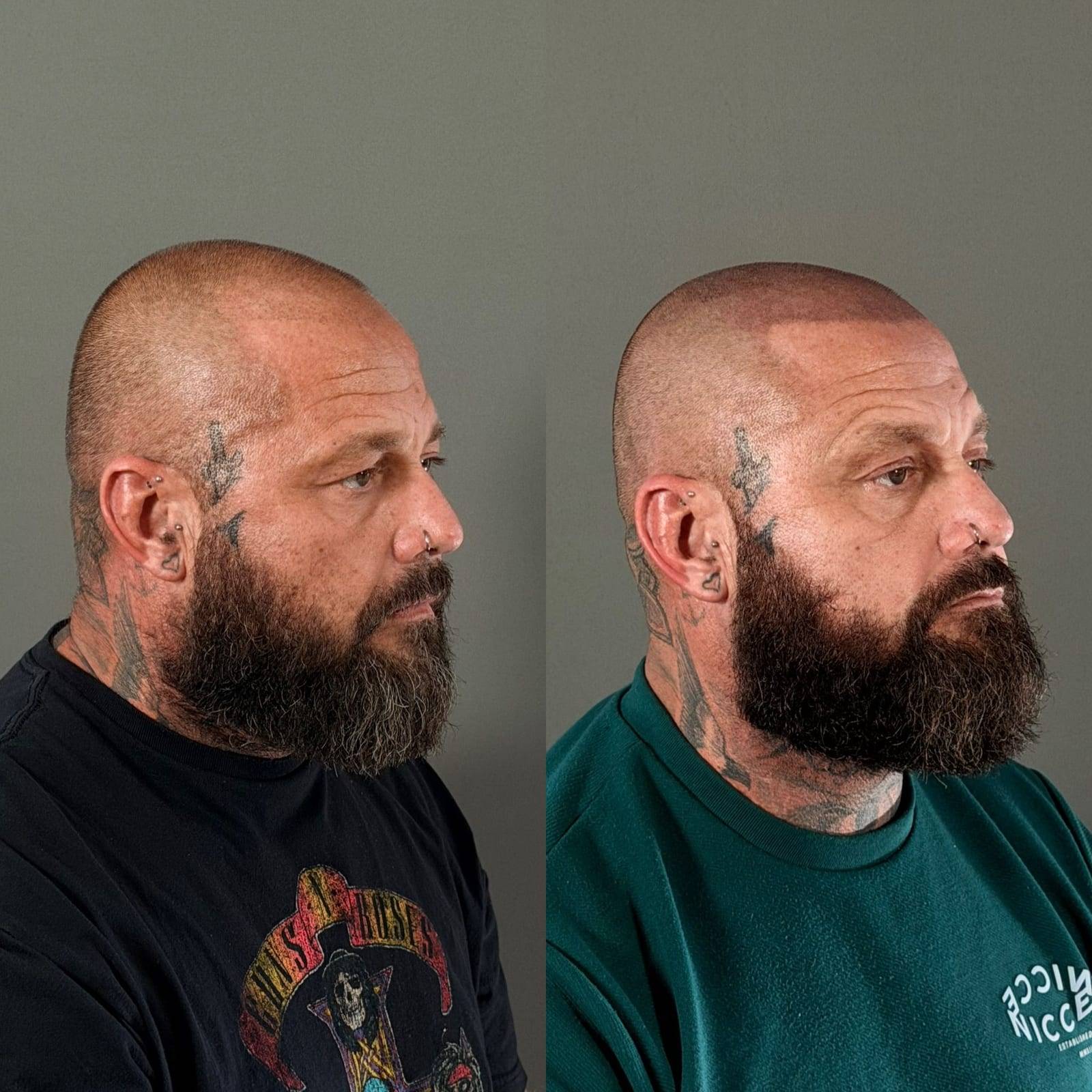
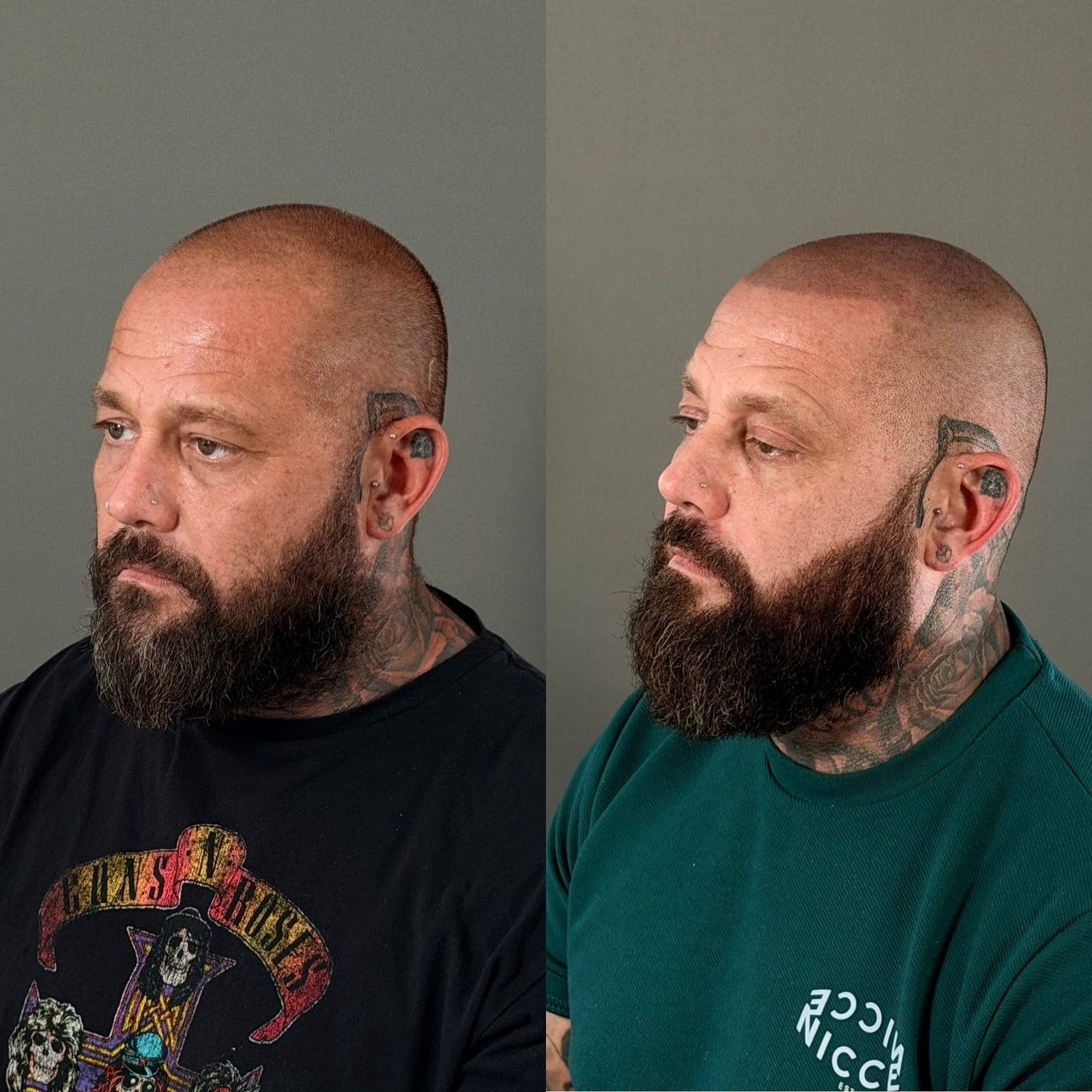
One thing in these photos is nothing to do with the treatment: Russ’s beard is darker in the after shots. SMP only treats the scalp, so judge the top of the head, not the beard.
How much does it cost to fix bad SMP?
After his consultation I gave Russ a fixed quote of £950 covering all four sessions. It was based on the condition of his existing pigment, the areas that needed correcting and the work I expected it to take, and he knew the full cost and what was included before he committed to anything.
Corrective SMP is priced case by case, because cases differ so much. Some people need a few small adjustments; others, like Russ, need extensive work over several sessions. Other UK studios that publish correction prices show the same spread: one lists correction at £450 to £750, another charges £500 per correction session, and a third starts at £500, with a laser-removal-and-correction package from £2,000 (prices checked November 2026).
Worth knowing before you book anywhere
Russ spent £350 on his first treatment and £950 putting it right. First-time scalp micropigmentation at this studio starts from £1,000, which you can compare on our prices page. A free consultation costs nothing.
If your SMP has simply faded, wherever it was done, that is a different and much smaller job: a touch-up, from £300, refreshes healthy work rather than rebuilding it.
Your options if your SMP has gone wrong
Corrective SMP over the top is one route of several, and it is not always the right one. The only peer-reviewed study of SMP revision I know of, Park and colleagues in 2024, followed 120 people at a Korean hair transplant clinic: 89.2% had originally been treated at a tattoo or cosmetic facility in a beauty salon, and the revisions they went on to have ranged from hair transplants to laser removal followed by new SMP. Being a surgical clinic’s patients, that mix leans towards surgery, but it shows how wide the choice really is.
In short, bad SMP is fixed in one of four ways, often combined:
- Blending and softening: building finer, even density around dark or blotchy areas so they stop standing out, as with Russ.
- Shade correction: using a different pigment tone so new work sits with the old instead of against it.
- Laser lightening or removal: when an area is too dark, too large or too blurred to disguise, or the hairline is in the wrong place.
- A different route altogether: letting it fade, growing hair over it, a hair system or a transplant.
Here is how the routes compare:
| Route | What it can realistically do | The catch | Typical UK cost |
|---|---|---|---|
| Leave it to fade | Costs nothing. SMP softens over the years; Cleveland Clinic says it usually holds its look for four years or longer | Slow, and nothing suggests a blown-out or blue patch fades back to clear skin | Free |
| Corrective SMP over the top | Evens out density, balance and shade, and camouflages dark patches by building around them. Russ’s route | Cannot shrink oversized or blurred dots; needs patience over several sessions | Quoted per case; other studios list £450 to £750, or about £500 a session |
| Laser lightening, then new SMP | Lightens or clears the old pigment so the new work starts from a cleaner base | Several sessions with healing gaps; around 3 in 100 scar at one NHS trust; no guarantee of full clearance | £55 to £250 a session at one NHS self-pay clinic, plus the new SMP |
| Laser removal on its own | Takes the scalp back towards bare skin | Same risks and gaps as above, and you lose the shaved look too | As above |
| Grow it out, or a hair system | Covers the scalp where your own hair still grows, or with a system | Only works if there is hair to grow; a system needs upkeep | Varies widely; see our hair system cost guide |
| Hair transplant | Adds real hair, the most common revision in the Park study | Surgery, needs enough donor hair, and is a far bigger cost | Thousands of pounds; see our hair transplant cost guide |
On laser specifically, the evidence is reassuring but small. A case series in Lasers in Surgery and Medicine cleared SMP in one to three sessions in all four patients, while UK clinics quote anything from one to six to lighten it, and up to ten for full removal. The NHS laser leaflet from Sandwell and West Birmingham explains that the body clears the broken-up pigment over eight to twelve weeks, that about 3 in 100 patients develop a scar in the treated area, and that it cannot guarantee 100% clearance. The NHS self-pay prices above come from Salisbury’s laser clinic (price list dated February 2024).
What corrective SMP can and cannot promise
Russ was very happy with how far his scalp came. Even so, his result is an improvement on difficult work, not a blank slate, and a few things hold true for anyone in his position:
- Camouflage is not removal. Dark, oversaturated areas can be blended so they stop drawing the eye, but the pigment underneath is still there.
- The after photos are not the healed result. Russ’s were taken straight after his final session. As with any SMP, the look continues to soften and settle as it heals, so the healed result may be softer.
- SMP does not grow hair. The NHS describes micropigmentation as a “tattoo used to look like short hair”. It changes how the scalp looks, nothing more.
- Results vary. How far a correction can go depends on how deep and dark the original work is, your skin, and your own hair.
If you are not sure which camp you are in, that is exactly what a consultation is for. My guide to scalp micropigmentation regrets covers how to avoid ending up here, and how long scalp micropigmentation lasts explains what normal fading looks like, which is worth knowing before you decide your SMP has gone wrong at all.
Checking a studio before anyone works on your scalp again
The second treatment deserves more scrutiny than the first did. In England outside London, anyone carrying out semi-permanent skin colouring must be registered with their local council under the Local Government (Miscellaneous Provisions) Act 1982, and our own council, West Suffolk, names micropigmentation in that category. London works differently: boroughs such as Wandsworth license it as a special treatment instead. That registration is about hygiene and premises, though. It does not require any SMP-specific qualification, so it tells you a studio is legal, not that it is skilled.
The skill you have to judge yourself. The NHS advice on choosing who does a cosmetic procedure is to book a consultation with the person who will actually do it, ask how many they have done and what happens if you are not happy, and not to pay until you have had that conversation. Look at their before-and-afters in consistent lighting, and if you are bringing in someone else’s work, ask whether they have corrected SMP before and what they would not take on.
What Russ’s case shows
Bad SMP can often be improved a long way, but not by simply adding more pigment. It took a frank conversation about limits, a small needle, shade changes from session to session, and the patience to wait four weeks before the last one. If you want the same look at your own scalp, the results page shows more of our work, and the consultation is free.
Common questions
Can bad scalp micropigmentation be fixed without laser?
Often it can be improved a great deal, but not always fully fixed. Where the old work is patchy, thin or unevenly balanced, new impressions placed carefully around it over several sessions can even out the density and soften the contrast, which is what I did for Russ. What corrective SMP cannot do is make an oversized, blurred or blown-out dot smaller, because you can only add pigment, never take it away. Those areas can be camouflaged by building density around them, but if you want them gone rather than disguised, laser lightening first is the honest route.
Can scalp micropigmentation be completely removed?
Usually, yes, with laser, though nobody can promise it. SMP pigment is dark and greyscale, which is the kind of tattoo pigment lasers generally deal with well. A small published case series found SMP cleared in one to three laser sessions, while UK clinics quote anything from one to six sessions to lighten it and up to ten for full removal, usually six to ten weeks apart. NHS laser services are careful to say they cannot guarantee complete clearance, and one NHS trust tells patients that around 3 in 100 develop a scar where they were treated. NHS England does not normally fund removal for cosmetic reasons, so expect to pay for it yourself.
How many sessions does corrective SMP take?
It depends on what is already there, which is why I only quote a correction after a consultation, once I have seen the work. Russ had four sessions. The first three were about two weeks apart, then I left four weeks before the last one so I could see how the new pigment had settled next to the old before refining it. Some other UK studios quote one to three sessions for correction work, but a scalp with oversaturated areas and blowouts needs more patience than one that is simply faded or a little thin. For first-time SMP, Cleveland Clinic describes three or more treatments spaced several weeks apart, so two sessions is usually a start rather than the finish.
Can scalp micropigmentation go wrong?
Yes, and when it does it is mostly down to depth and how much pigment went into one spot. Pigment placed too deep spreads under the skin and turns blotchy, and putting too much pigment into a small area makes the impressions blur into each other. Over time, dark pigment in the skin can also take on a bluish or blue-grey tone, which researchers have recorded even with pure black pigment. The International Society of Hair Restoration Surgery notes that tattoo ink is often placed deeper than is ideal or with a larger needle, both of which make these problems more likely. Many cases can still be improved with corrective SMP, and laser can lighten what cannot.
How much does it cost to fix bad scalp micropigmentation?
Corrections are priced individually because no two are the same. Russ's fixed quote, agreed at his consultation, was £950 for all four sessions, so he knew the total before we started. Other UK studios that publish correction prices list £450 to £750 for a package or about £500 a session, and laser lightening is charged per session on top if it is needed. Our current prices for first-time SMP and touch-ups are on the prices page.
Do the after photos show the fully healed result?
No, and it is worth being clear about that. Russ's after photos were taken immediately after his fourth and final session. The pigment from his first three sessions had already healed and settled, but the last refinements were still fresh. As with any SMP, the look continues to soften and settle during healing, so the fully healed result may appear softer than the photos.
Unhappy with SMP you had somewhere else?
Come in for a free consultation and I will look at the work in good light and tell you straight whether it can be corrected over the top, needs lightening first, or is better left alone.
Book a free consultationMore from the blog
Bald Head Care in Winter (2026): A 6-Step Routine, Dry Scalp and Your SMP
Three questions come up in the chair at this time of year: why has my head gone dry and flaky, is it dandruff, and is the cold doing anything to my SMP? Here is what the evidence says, and where it runs out.
How Long Does Scalp Micropigmentation Last? The Honest Timeline
Every SMP page says three to six years and stops there. Here is the actual reason pigment fades, the factors that genuinely speed it up, and an honest answer on when you will want a touch-up.
Density SMP Treatment After One Session
A first density SMP session can already soften the contrast between hair and scalp on thinning areas, but a natural, settled result is built gradually. Here is a realistic look at what one session can and cannot do.